



Fossil Relics from the Cosmic Dawn
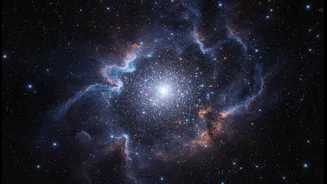
Imagine looking back in time over 13 billion years. That's what astronomers are doing with the Hubble Space Telescope, and they've found something remarkable: ancient globular clusters. These are dense, spherical collections of hundreds of thousands,
or even millions, of stars all bound together by gravity. The clusters recently observed are among the oldest objects ever found, having formed when the universe was just a few hundred million years old. Think of them as fossil relics. Because they are so old, the stars within them have very low levels of heavy elements, which astronomers call 'metals'. This indicates they formed from the pristine gas that existed shortly after the Big Bang, before generations of stars had a chance to create and scatter heavier elements across the cosmos.
A Cosmic Time Machine at Work
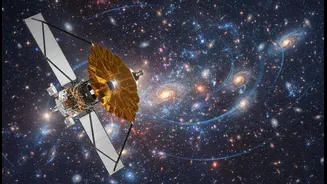
Finding these ancient stellar cities is no easy task. They are incredibly far away, and their light has been traveling for over 13 billion years to reach us. Hubble's great power lies in its ability to act as a time machine; by looking at the most distant objects, it sees them as they were in the remote past. The light from these ancient clusters is also stretched to redder wavelengths by the expansion of the universe, a phenomenon known as redshift. In some cases, astronomers get a helping hand from a cosmic phenomenon predicted by Albert Einstein called gravitational lensing, where the gravity of a massive foreground object, like a galaxy cluster, magnifies the light from the even more distant object behind it. This combination of powerful optics and natural magnification allows Hubble to spot these faint, ancient structures.
Rewriting the Story of Galaxies
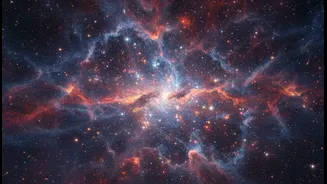
This discovery does more than just set a new record for old stars; it forces a rethink of how galaxies like our own Milky Way came to be. For a long time, globular clusters were thought to contain stars all born in a single event. However, detailed observations, including recent ones from Hubble, suggest some of these ancient clusters contain multiple generations of stars. This complicates the picture. Furthermore, the leading theory of galaxy formation, known as hierarchical formation, suggests that large galaxies are built up over billions of years as smaller galaxies and star clusters merge together. Finding such massive, well-formed globular clusters so early in the universe's history is a puzzle. They may be the surviving 'building blocks' or cores of the very first protogalaxies that were later absorbed into larger structures. This finding provides compelling evidence for the hierarchical model but also suggests the process started much earlier and more vigorously than previously thought.
The Search Continues
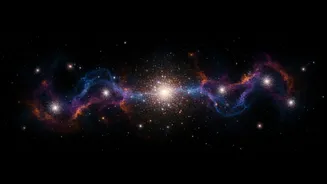
While Hubble has been the workhorse for decades, its discoveries have paved the way for the next generation of observatories. The James Webb Space Telescope (JWST), with its powerful infrared vision, is perfectly suited to peer even deeper into the cosmic past, studying these early clusters in greater detail than ever before. Recent simulations suggest that some of these proto-globular clusters may not have formed in the chaotic centers of young galaxies, but in the comparatively quiet gas filaments that fed them, an idea that telescopes like JWST are now testing. By studying the chemical makeup and motions of stars within these ancient clusters, scientists hope to answer fundamental questions about the first stars and the reionization of the universe—the period when the first luminous objects cleared the cosmic fog of neutral hydrogen. Each discovery is a crucial piece of the puzzle, helping us narrate the 13.8-billion-year story of our universe.