



The Universe’s First Ingredients
Moments after the Big Bang, the entire universe was an incredibly hot, dense soup of energy and particles. As it expanded and cooled, the first atomic nuclei began to form in a process called Big Bang Nucleosynthesis (BBN). This cornerstone theory of cosmology
makes a very specific prediction: the early universe should have been composed of roughly 75% hydrogen and 25% helium by mass, with trace amounts of light elements like lithium. For decades, this has been a fundamental, yet difficult to prove, aspect of our cosmic origin story. Verifying it requires finding and analysing matter that is almost as old as the universe itself, before countless generations of stars altered that primordial chemical mix.
In Search of Cosmic Fossils
Stars are cosmic recycling plants. They fuse lighter elements into heavier ones in their cores. When they die, they disperse these new elements—which astronomers call “metals”—into space, enriching the raw material for the next generation of stars. This means that to measure the original, primordial concentration of helium, scientists need to find stars that are as “unpolluted” as possible. Ideally, they would study the very first generation of stars. But finding these elusive objects is incredibly difficult. The next best thing is to find extremely old, dense collections of stars that formed when the universe was very young, known as globular clusters. These act as cosmic fossils, preserving the chemical signature of the early universe.
Enter the ‘Sparkler’ Galaxy
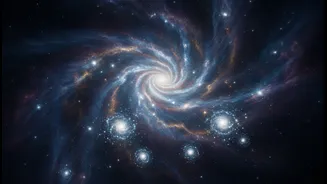
In one of its first deep-field images, the James Webb Space Telescope (JWST) revealed a stunning distant object nicknamed the “Sparkler” galaxy. Located nine billion light-years away, we see it as it was when the universe was only about 4.5 billion years old. Its light is magnified by a massive galaxy cluster in front of it, an effect called gravitational lensing, allowing JWST to see it in unprecedented detail. Surrounding this galaxy are a dozen glittering points of light—the “sparkles” that give it its name. Astronomers quickly realised these were not just individual stars, but something much more significant.
Ancient Clusters at the Dawn of Time
Analysis confirmed that at least five of these sparkles are ancient globular clusters. These are dense, spherical swarms of millions of stars, all bound together by gravity. What makes them extraordinary is their age. The data suggests these clusters formed just 500 million years after the Big Bang, making them some of the oldest stellar systems ever discovered. They have long since stopped forming new stars, so their chemical makeup is a direct snapshot of the galactic environment from over 13 billion years ago. Their extreme density and ancient nature make them the perfect laboratories to finally put the predictions of Big Bang Nucleosynthesis to a direct observational test.
Reading the Primordial Signature
So, what do these dense stellar cores indicate? By using spectroscopy, astronomers can spread the light from these distant clusters into a rainbow-like spectrum. Within this spectrum, dark lines appear where specific elements have absorbed light. This pattern acts as a chemical fingerprint, allowing scientists to measure the abundance of different elements like hydrogen and helium within the clusters' stars. Since these stars are so ancient and metal-poor, their composition is expected to closely match the primordial mix of the early universe. The presence of these clusters, now observable by JWST, indicates that astronomers have a direct line of sight to measure the helium concentration from the dawn of time. This provides a powerful method to confirm whether the universe was indeed cooked with the 25% helium recipe predicted by our leading cosmological theories.