





Listening to Spacetime Ripples
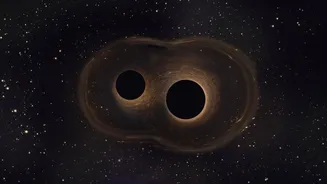
Imagine throwing two bowling balls into a trampoline. The impact would create ripples spreading across the surface. This is a simple way to think about gravitational waves. When massive objects like black holes collide, they create ripples in the very
fabric of spacetime. First predicted by Albert Einstein a century ago, these waves were only directly detected for the first time in 2015 by the Laser Interferometer Gravitational-wave Observatory (LIGO). These observatories are giant L-shaped detectors that can sense impossibly small distortions in spacetime—far smaller than the width of a proton—caused by cosmic collisions that happened billions of light-years away. By analysing these signals, scientists can determine the masses and other properties of the colliding objects, opening a new window onto the universe's most extreme events.
The Black Hole Family Mystery
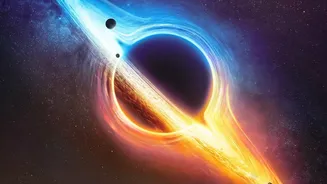
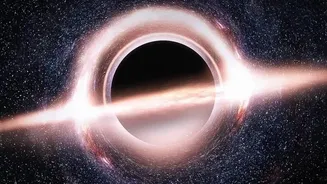
Astronomers know of two main types of black holes. The first are 'stellar-mass' black holes, which are typically 5 to a few dozen times the mass of our sun, formed from the collapse of a single massive star. At the other end of the spectrum are 'supermassive' black holes, found at the centers of most large galaxies, including our own Milky Way, with masses millions or even billions of times that of the sun. But what about the ones in between? This category, known as intermediate-mass black holes (IMBHs), with masses from a hundred to hundreds of thousands of times that of the sun, has been notoriously difficult to find. They are the crucial missing piece of the puzzle, as they are believed to be the seeds from which supermassive black holes grow.
What the New Signals Reveal
Finding IMBHs is so important because it helps explain how the universe evolved. Recent detections of gravitational waves from merging black holes are providing the first concrete evidence for how these mid-sized monsters form and grow. Some signals show black holes merging to create a final product that falls squarely in the IMBH mass range. Other detections suggest a process called 'hierarchical merging,' where black holes that are themselves the products of previous mergers collide again, steadily building up mass. For example, recent analysis shows that for some black hole collisions, it's not their first rodeo; they are second or third-generation mergers. This pathway helps explain how black holes can grow to sizes that are seemingly forbidden by standard models of stellar evolution.
A New Chapter for Indian Astronomy
India is poised to become a central player in this exciting field. The new LIGO-India observatory, which broke ground in Maharashtra in early 2026, will soon join the global network of gravitational-wave detectors that includes facilities in the US, Italy, and Japan. The location of LIGO-India is crucial. By adding another 'ear' to the network at a large distance from the others, it will dramatically improve scientists' ability to triangulate the exact location of a gravitational wave source in the sky. This enhanced precision is vital for 'multi-messenger astronomy'—allowing conventional telescopes to quickly find and study the light, X-rays, or radio waves from the same event that produced the gravitational waves. With the observatory expected to house technology even more advanced than current detectors, India will be at the forefront of decoding the universe's most powerful secrets.