




Healthcare Professionals: An AI-Powered Diagnosis
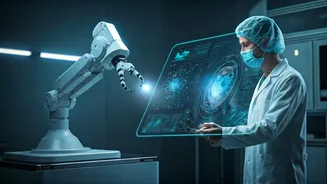
In healthcare, AI is not replacing the empathetic care of doctors and nurses but is augmenting their abilities in powerful ways. AI algorithms can analyze medical images like MRI and CT scans with incredible speed and accuracy, helping radiologists identify
diseases like cancer earlier and more reliably. These systems can sift through millions of data points to detect patterns that might be invisible to the human eye. This allows healthcare professionals to focus less on repetitive diagnostic tasks and more on complex decision-making and patient care. In India, for instance, AI-powered tools are being developed and used for early detection of diseases and to bring specialist-level diagnostics to remote areas. By automating administrative work like scheduling and managing patient records, AI also frees up valuable time for clinicians to spend on what matters most: their patients.
Legal Professionals: The Automated Advocate
The legal field, traditionally reliant on painstaking manual research, is undergoing a significant transformation. AI is now a crucial tool for lawyers, automating tasks that once consumed hundreds of hours. Legal AI platforms can scan thousands of legal documents, precedents, and cases in mere seconds, streamlining the research process. These tools also excel at contract analysis, quickly identifying risky clauses and inconsistencies in large volumes of documents, a process known as technology-assisted review (TAR). This doesn't make lawyers obsolete; it allows them to focus on higher-level strategy, client counsel, and crafting more persuasive arguments. By handling the burdensome, repetitive work, AI increases efficiency, reduces errors, and can even make legal services more affordable and accessible.
Creative Professionals: The New Muse
Contrary to fears that AI would kill creativity, many artists, writers, and designers are embracing it as a collaborative tool. In India, the creative workforce is particularly optimistic, with a majority believing AI will have a positive impact on their industry. AI tools can generate ideas, create first drafts of ad copy or articles, and produce visual inspiration, acting as a tireless brainstorming partner. For filmmakers and editors, AI can assist with tasks like visual effects, storyboarding, and even initial editing cuts. For marketers, AI analyzes vast amounts of consumer data to personalize campaigns and predict trends far more effectively than manual methods. The human creator remains essential for providing the vision, cultural understanding, and emotional depth that AI cannot replicate.
Educators: Personalizing the Learning Journey
AI is emerging as a powerful assistant for teachers, helping to tackle administrative burdens and personalize education. AI tools can help educators create lesson plans, generate quizzes, and even draft newsletters for parents, saving significant time. More importantly, AI offers the ability to create customized learning paths for students. It can provide adaptive exercises that adjust to a student's performance, offer instant feedback, and present information in different ways to suit various learning styles. This frees up teachers to focus on mentoring, inspiring students, and providing the crucial emotional and social support that technology can't deliver.
Software Developers: A Smarter Coding Partner
Even the creators of our digital world, software developers, are using AI to enhance their own work. AI-powered coding assistants can suggest lines or blocks of code, identify bugs, and automate testing, significantly speeding up the development process. These tools act like a pair-programmer that never sleeps, helping developers write cleaner, more efficient code. Rather than replacing developers, these AI assistants allow them to tackle more complex problems and focus on system architecture and innovative feature design. This collaboration boosts productivity and lets developers spend more time on the creative aspects of software engineering.