






The Legend of the Seven Pagodas
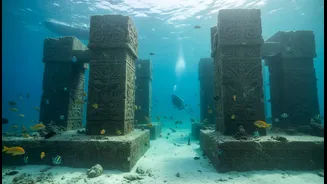
The story of Mahabalipuram is incomplete without the myth of the Seven Pagodas. Ancient folklore, repeated by European sailors for centuries, speaks of a glorious city with seven temples lining the shore, their golden spires visible from far out at sea.
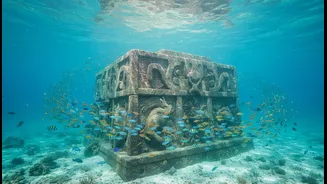
The legend says the gods grew jealous of the city's beauty and sent a great flood, submerging six of the seven temples, leaving only the Shore Temple to stand as a lonely sentinel against the waves. For generations, this was considered just a story, a romantic tale to explain the solitary grandeur of the surviving temple. But as fishermen and locals continued to speak of seeing ruins in the water, the line between myth and history began to blur.
From Myth to Mission
The turning point came during the devastating 2004 tsunami. As the sea pulled back from the coastline in a terrifying prelude, eyewitnesses reported seeing long rows of large stone structures emerge from the water before being consumed again by the returning waves. This dramatic event turned a local legend into a global headline and a scientific priority. It provided compelling anecdotal evidence that something substantial lay submerged just off the coast. This prompted renewed and more intensive investigations by scientific bodies like the National Institute of Oceanography (NIO) and the Archaeological Survey of India (ASI), who launched missions to systematically map the seabed and verify the claims.
Diving into the Deep
Exploring the seabed is no simple task. The teams from the ASI and NIO have employed a range of technologies to peer through the ocean's depths. Early explorations used sonar to scan the ocean floor, revealing anomalies that suggested man-made formations. Divers were then sent down to investigate these targets. In more recent explorations, which resumed in 2025, archaeologists have been equipped with advanced tools like Remotely Operated Vehicles (ROVs). These unmanned submersibles can navigate challenging underwater environments, capturing high-resolution video and images without disturbing the fragile archaeological site, allowing for safer and more precise documentation of what lies beneath.
What Lies Beneath?
The results have been tantalising. Investigations have confirmed the existence of submerged man-made structures scattered over a large area. Divers have documented fallen walls, flights of stairs, and numerous dressed stone blocks bearing chisel marks, all lying at depths of around 5 to 8 metres. The layout suggests that these are not random rocks but the remains of a significant building complex. While not yet definitively proving the legend of six distinct temples, the evidence strongly indicates that a large part of the ancient city of Mahabalipuram was indeed lost to the sea. Radiocarbon dating of materials found on the structures suggests the submergence may have happened in phases, possibly due to tsunamis or gradual coastal erosion centuries ago.
The Sea as Both Destroyer and Preserver
This brings us back to the central question: can the sea truly preserve history? The answer is complex. The same force that can swallow a city can also act as a remarkable time capsule. Submerged structures are protected from the destructive forces of wind, rain, and, most importantly, human activity. The low-oxygen environment of the seabed can slow down decay, preserving materials that would have long since vanished on land. Of course, the sea is not a gentle guardian. Strong currents can scatter ruins, and saltwater is corrosive. Yet, as the Mahabalipuram findings show, significant parts of our heritage can and do survive beneath the waves, waiting for us to find them.