



An Analogue, Not an Accident
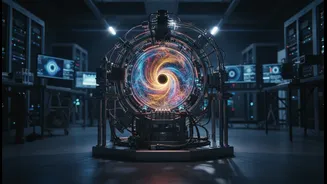
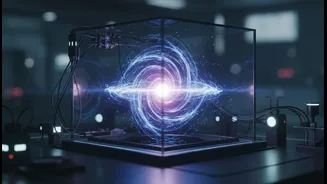
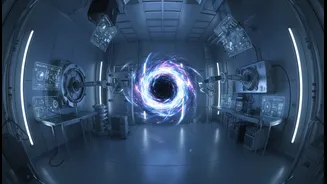
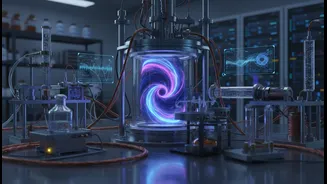
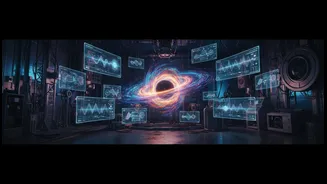
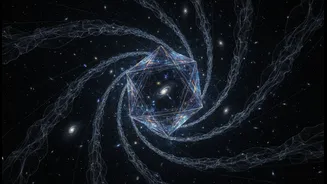
First, let's be clear: scientists are not creating miniature planet-destroying black holes. Instead, they are building 'analogue' systems. These are controllable laboratory setups that follow the same mathematical rules as the cosmic phenomena they are designed
to study. Think of it like a flight simulator for pilots; it recreates the experience and physics of flying without leaving the ground. In the world of analogue gravity, phenomena like water swirling down a drain or sound waves in a super-cooled gas can be manipulated to create a point of no return, much like a black hole's event horizon. This allows researchers to safely probe the physics of these extreme environments, something impossible to do with actual black holes that are thousands of light-years away.
The Magic of Metamaterials
The key to this latest experiment lies in a category of substances known as metamaterials. These are not materials found in nature but are artificially engineered structures designed to manipulate waves—like light or sound—in ways that are otherwise impossible. The most recent innovation involves 'time-varying' metamaterials. While traditional metamaterials have fixed properties determined by their physical structure, these new versions can have their properties, such as their refractive index, changed rapidly over time. This is often done by applying an electrical or magnetic field. By modulating the material's properties in a carefully controlled sequence, physicists can create the illusion of movement or generate strange optical effects, effectively tricking waves into behaving as if they are interacting with a gravitational field.
Simulating the Point of No Return
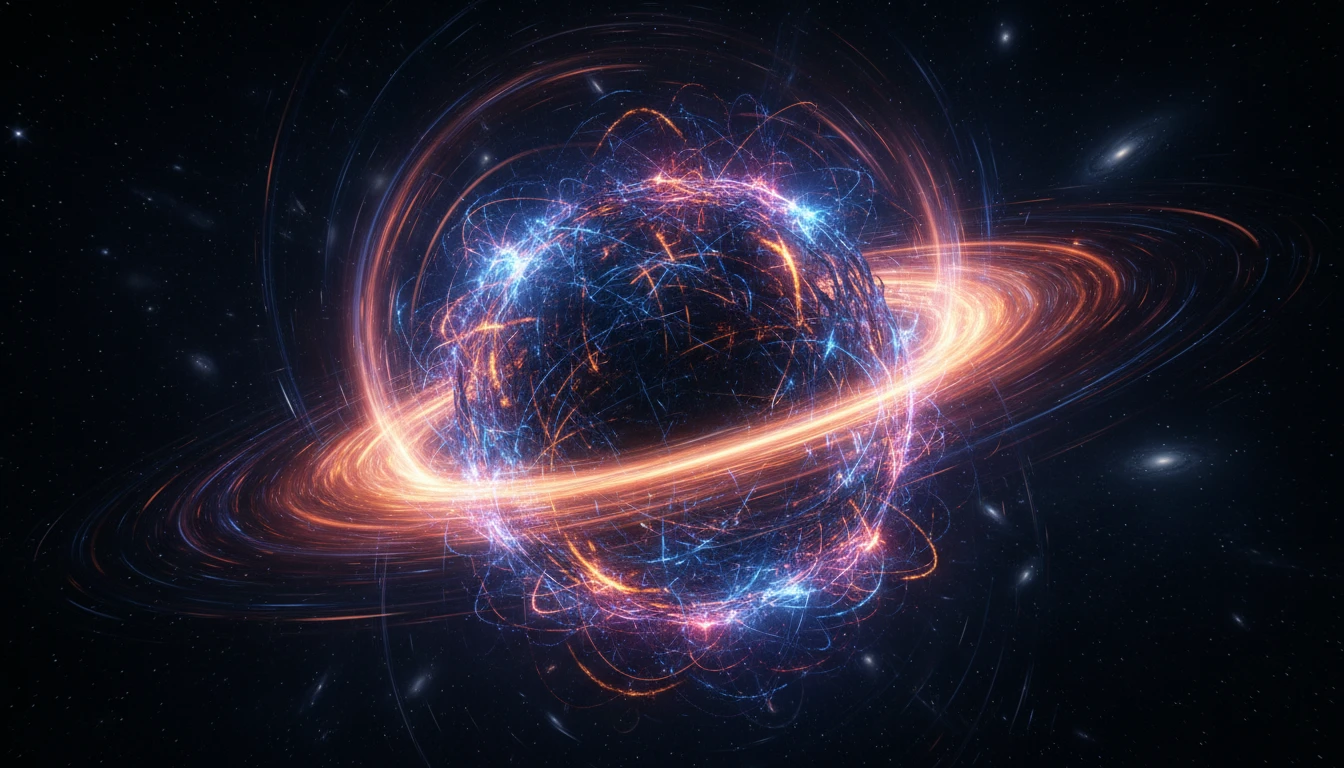
In these experiments, scientists use these time-varying materials to create an 'optical event horizon' for light waves. By rapidly changing the material's properties, they can create a boundary where the conditions change so fast that light waves get trapped, unable to escape—just as nothing can escape the gravitational pull of a real black hole beyond its event horizon. One recent experiment used a ring of these metamaterials. By modulating the electrical properties around the ring in a specific pattern, researchers simulated an object rotating faster than light, without anything physically moving. This created an environment where waves entering the system could actually gain energy, a phenomenon predicted decades ago.
Chasing Stephen Hawking's Ghost
The primary goal of many of these analogue experiments is to observe a phenomenon predicted by Stephen Hawking in 1974. He theorized that black holes are not completely black but should faintly glow, emitting what is now known as Hawking radiation. This radiation is created by quantum fluctuations at the edge of the event horizon. However, for any known astrophysical black hole, this glow is far too faint to detect against the background radiation of the universe. By creating analogue event horizons in the lab, scientists can amplify these effects and study the process up close. Several experiments using different analogue systems, including chains of atoms and optical fibers, have reported observing the equivalent of Hawking radiation, providing strong evidence for Hawking's groundbreaking theory.
A New Toolkit for Fundamental Physics
This research is more than just a clever party trick. It represents a new frontier in experimental physics, allowing scientists to test theories that connect Einstein's theory of general relativity with quantum mechanics—two pillars of modern physics that are famously difficult to reconcile. These tabletop experiments could shed light on some of the deepest questions in cosmology, such as the nature of dark matter or what happened in the very first moments of the universe. While the technology of time-varying metamaterials is still in its early stages, it also holds promise for more practical applications in next-generation communication systems, advanced sensors, and radar technology by enabling unprecedented control over electromagnetic waves.