






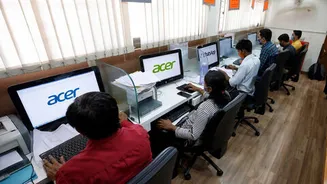
For years, the story has been simple: automation, led by AI, will eliminate jobs and empty our cities' glass-and-steel towers. A surprising new forecast suggests the exact opposite for India, projecting a massive increase in office workers.
The 48 Million Worker Forecast
Contrary to
the widespread narrative of AI-induced job losses, a recent report from real estate consultancy Cushman & Wakefield projects that India's office-based workforce will swell to 48 million by 2030. This represents a significant jump from the estimated 38 million in 2025, an addition of nearly 10 million workers, or about 1.8 million new office jobs annually. This growth isn't happening despite automation but is intricately linked to it. The key finding is that AI is set to change the nature of office work and the demand for space, rather than simply reducing it. As routine tasks get automated, the Indian economy is creating higher-value roles that still require a collaborative, physical office environment.
The Engine Room: Global Capability Centres
The primary engine driving this growth is the phenomenal expansion of Global Capability Centres (GCCs). Once seen as cost-saving back-offices for multinational corporations, India's GCCs have transformed into strategic hubs for innovation, research and development, product engineering, and data analytics. These centres now account for a massive share of commercial office leasing, with some estimates suggesting they take up nearly 40% of Grade-A office space. Rather than handling simple outsourced tasks, today's GCCs are home to highly skilled professionals who manage complex global functions. This shift from 'cost centres' to 'capability centres' means companies are investing in large, high-quality, and long-term office campuses designed for collaboration and innovation, anchoring demand for years to come.
Job Transformation, Not Elimination
The fear of automation often focuses on job replacement. However, the reality on the ground in India appears to be one of job transformation. As AI handles repetitive and routine cognitive tasks, the demand for employees who can supervise, validate, and make judgment calls that AI cannot is increasing. This leads to a workforce that is leaner but more senior-heavy and expert-driven. Even in manufacturing, some firms have found that automation allows them to hire less-skilled workers and train them quickly for complex jobs, because technology provides guidance and ensures quality, boosting overall employment. The focus is shifting from pure execution to roles that require uniquely human skills: strategic thinking, creativity, and complex problem-solving. These are precisely the activities that benefit from in person collaboration.
The New Role of the Office
If the workforce is growing and the nature of work is changing, what does this mean for the office itself? The consensus is that the office's role is evolving from a place for individual task execution to a hub for collaboration, culture, and innovation. The rise of AI makes it difficult for companies to predict their exact headcount needs, leading many to favour more flexible workspace solutions over rigid, long term leases. The 'AI office' is less about rows of desks and more about creating high quality, digitally enabled environments that foster teamwork and attract top talent. Companies are looking for adaptable spaces that can support a more senior, expert workforce, which ironically may mean more space per person, not less, to accommodate collaborative zones and advanced infrastructure.