
Venus: The Hostile Sister Planet
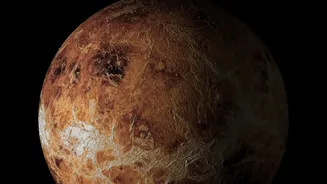
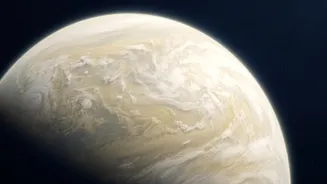
Venus and Earth are similar in size, mass, and density, earning them the nickname of planetary twins. But the similarities stop there. Venus is the hottest planet in our solar system, with surface temperatures that can melt lead and an atmospheric pressure
over 90 times that of Earth's. Its skies are permanently shrouded in thick clouds of sulfuric acid, which create a runaway greenhouse effect. This extreme environment serves as a cautionary tale for climate change on our own planet, and understanding why our twin evolved so differently is a key driver of modern space exploration.
Shukrayaan-1: India’s Ambitious Quest
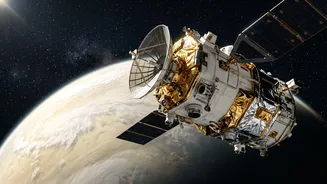
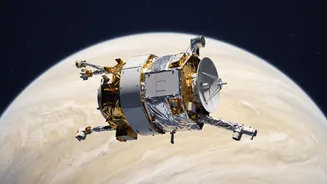
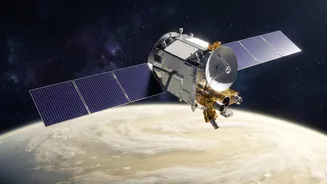
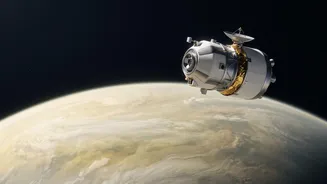
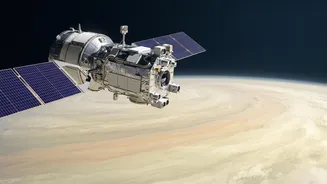
Enter Shukrayaan-1, the Venus Orbiter Mission from the Indian Space Research Organisation (ISRO). Following its celebrated missions to the Moon and Mars, ISRO is setting its sights on our other planetary neighbour. Approved by the Indian government, the mission is planned for a 2028 launch aboard the powerful LVM-3 rocket. The orbiter will carry around 100 kg of scientific instruments into a polar orbit around Venus. To save fuel and maximise its scientific payload, the spacecraft will use a technique called aerobraking—dipping into the upper atmosphere to gradually slow down and lower its orbit into the ideal position for observation.
Piercing the Veil with Radar
The most significant challenge in studying Venus is its impenetrable cloud cover. To see through it, Shukrayaan-1 will be equipped with a powerful S-Band Synthetic Aperture Radar (SAR). This flagship instrument works by sending radar waves that can pass through the clouds, bounce off the solid surface, and return to the orbiter. By analysing these echoes, scientists can create high-resolution maps of the planet's surface, revealing volcanoes, craters, and other geological features with a precision expected to be four times greater than NASA's Magellan mission in the 1990s. The mission will also carry a ground-penetrating radar, a first for Venus exploration, to study the planet's subsurface layers.
Decoding the Atmosphere's Chemistry
While the radar maps the ground, a different set of instruments will focus on the atmosphere itself. The Venus InfraRed Atmospheric Gases Linker (VIRAL), an instrument co-developed with Russia and France, is designed to analyse the chemical makeup of the atmosphere above the clouds. Spectrometers and thermal cameras will measure the composition and temperature of different atmospheric layers. These sensors will hunt for key gases and aerosols, map cloud movements, and even look for lightning. This data is crucial for understanding the planet's extreme climate dynamics and how gases released from potential volcanic activity contribute to the thick, toxic air.
Studying the Solar Wind Interaction
Venus lacks a protective global magnetic field like Earth's, leaving its upper atmosphere exposed to the constant barrage of the solar wind—a stream of charged particles from the Sun. Several instruments on Shukrayaan-1, including the Venusian Neutrals Analyser (VNA) provided by Sweden, will study this interaction. The VNA is part of a broader plasma analyser package called VISWAS, which will measure how these solar particles strip away gases from the Venusian atmosphere. Understanding this process of atmospheric escape helps explain how Venus lost its ancient water and evolved into the arid, hostile world it is today.