



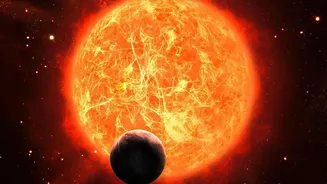
A Glimpse of Water Across the Void
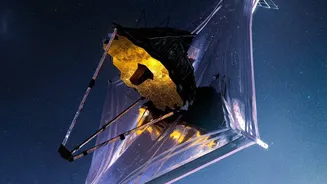
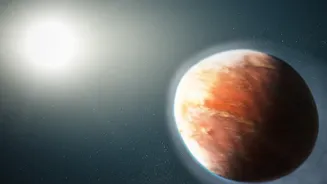
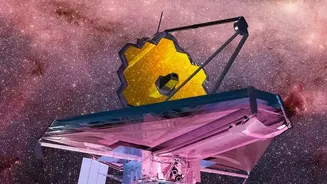
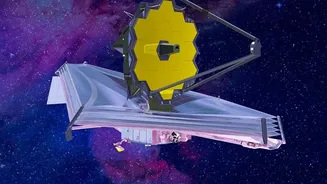
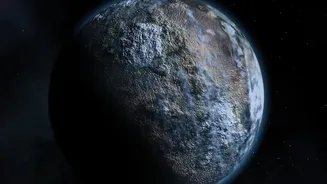
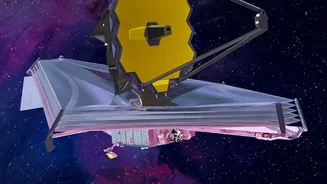
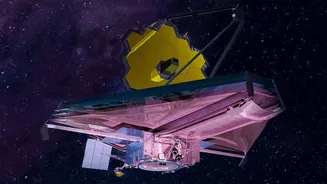
In a recent breakthrough, the James Webb Space Telescope has provided our most detailed look yet into the atmosphere of a distant 'super-Earth' named K2-18 b, located about 120 light-years from us. The telescope detected the clear chemical signatures
of water vapour, alongside methane and carbon dioxide. This marks a pivotal moment in astronomy; while water has been found elsewhere in the cosmos, finding it in the atmosphere of a planet that resides in its star's 'habitable zone' is a significant step forward. The habitable zone is the orbital region where temperatures are just right for liquid water to potentially exist on a planet's surface. The presence of carbon-bearing molecules further elevates the planet's status as a subject of intense scientific interest.
What Exactly Is a 'Super-Earth'?
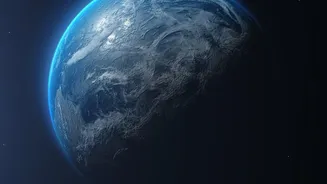
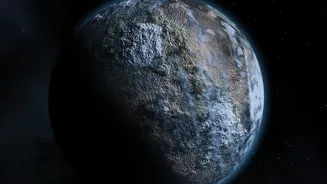
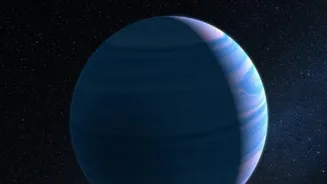
The term 'super-Earth' might conjure images of a bigger, better version of our own world, but the reality is more complex and diverse. This classification refers to exoplanets with a mass higher than Earth’s but substantially below that of our solar system's ice giants, Neptune and Uranus. K2-18 b, for example, is about 8.6 times more massive than Earth. Our solar system doesn't contain any super-Earths, making them a fascinating mystery. They could be larger rocky planets or, as many scientists now suspect in the case of K2-18 b, they could belong to a new class of planet entirely: a 'Hycean' world. This term, a combination of 'hydrogen' and 'ocean,' describes a hypothetical planet with a liquid water ocean beneath a dense, hydrogen-rich atmosphere.
The Power of Spectroscopy
How can scientists know what’s in the atmosphere of a planet light-years away? The answer lies in a powerful technique called transit spectroscopy. As an exoplanet passes in front of its host star from our perspective, a tiny fraction of the starlight filters through the planet's atmosphere. The JWST's incredibly sensitive instruments, like its Near-Infrared Spectrograph (NIRSpec), capture this light. Different gases in the atmosphere absorb specific wavelengths, or colours, of light, leaving a unique chemical fingerprint on the starlight's spectrum. By analysing which colours are missing, astronomers can deduce the atmospheric composition with remarkable precision, identifying molecules like water, methane, and carbon dioxide from across the galaxy.
Habitable, But Not Necessarily Inhabited
The detection of water vapour is thrilling, but it is not proof of life or even of Earth-like oceans. Scientists are careful to manage expectations. A Hycean world like K2-18 b could have an ocean, but it might be boiling hot. The planet's large size and massive, hydrogen-rich atmosphere create conditions very different from Earth's. However, the discovery of these ingredients in the atmosphere is precisely what the JWST was built to do. It opens the door to considering a wider range of environments that could potentially support life. Traditionally, the search focused on smaller, rocky planets, but these larger Hycean worlds are easier to observe, making them prime targets for follow-up studies.
A New Era for Astronomy
This discovery is more than just a single data point; it represents the dawn of a new era in the search for life beyond Earth. With the JWST, we have moved from merely detecting exoplanets to being able to characterise their atmospheres in detail. The observations of K2-18 b are a powerful demonstration of the telescope's capabilities, confirming its potential to fundamentally reshape our understanding of the cosmos. Future observations will aim to confirm these initial findings and search for even more telling molecules, including potential biosignatures—gases that, on Earth, are produced almost exclusively by life. Each observation brings us one step closer to answering one of humanity’s oldest questions: are we alone?