



When we see stunning images of space, we see swirling clouds and vast spirals of light. But what are we looking at? While both are beautiful, a nebula and a galaxy are fundamentally different. Let's break down these cosmic structures.
Cosmic Ingredients: Gas Cloud vs. Star City
The most basic difference
lies in what they're made of. A nebula is an interstellar cloud composed of gas and dust. Its primary ingredients are hydrogen and helium, with trace amounts of other elements. Think of it as the raw material of the cosmos. A galaxy, on the other hand, is a massive, gravitationally bound system containing billions or even trillions of stars, along with their solar systems, star clusters, dust, gas, and dark matter. In short, a nebula is a cloud of gas and dust that exists inside a galaxy. A galaxy is the sprawling city, and nebulae are some of the workshops within it.
A Question of Scale: Local Cloud vs. Island Universe
The difference in scale is immense. Nebulae can be vast, often spanning several hundred light-years across. The famous Orion Nebula, for example, is about 24 light-years wide. However, this is tiny compared to a galaxy. Our own Milky Way galaxy is about 100,000 light-years in diameter. Some giant galaxies can stretch for over a million light-years. To put it in perspective, comparing a nebula to a galaxy is like comparing a single cloud in Earth's atmosphere to the entire planet. All known nebulae are located within galaxies.
Cosmic Jobs: Nurseries and Graveyards
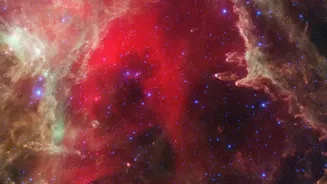
Nebulae and galaxies have very different functions. Many nebulae are known as 'stellar nurseries'. Within these dense clouds, gravity pulls gas and dust together to form new stars. The iconic 'Pillars of Creation' in the Eagle Nebula is a famous example of this star-birthing process. Other types of nebulae are formed at the end of a star's life. When a star like our sun dies, it sheds its outer layers, creating a beautiful, glowing structure called a planetary nebula. When a much more massive star explodes in a supernova, it leaves behind a chaotic remnant nebula. In this way, nebulae serve as both the cradles and graveyards for stars, recycling material for future generations.
Structure and Appearance
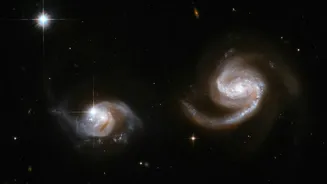
Galaxies are organised structures, generally classified into types like spiral, elliptical, and irregular, all held together by gravity, often with a supermassive black hole at the center. They are vast collections of stars. Nebulae, by contrast, are more amorphous clouds. Their appearance depends on how they interact with nearby starlight. Emission nebulae, like the Orion Nebula, are hot enough to glow with their own colourful light. Reflection nebulae shine by reflecting the light of nearby stars, often appearing blue. Dark nebulae are so dense with dust that they block the light from objects behind them, appearing as dark patches against a brighter background, like the famous Horsehead Nebula. Historically, before telescopes were powerful enough to resolve them, distant galaxies that looked like fuzzy blobs were also called nebulae, which caused confusion for early astronomers.