







A Day Longer Than a Year
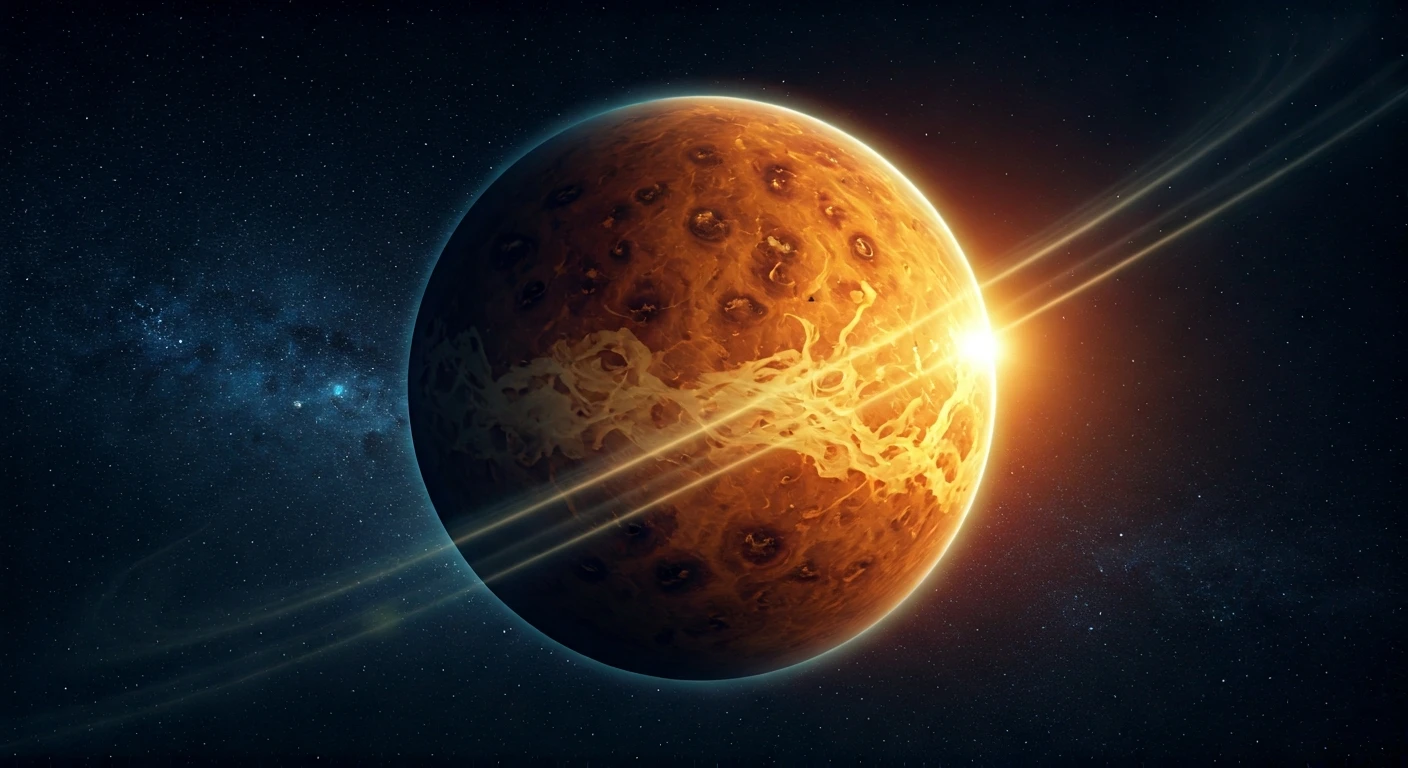
Let's get the mind-bending numbers out of the way first. Venus takes about 225 Earth days to complete one full orbit around the Sun. This is its year. However, it takes a staggering 243 Earth days for the planet to complete a single rotation on its axis.
This is its day. You could celebrate your birthday on Venus before a full day-night cycle has even passed. To make things even stranger, Venus spins backwards. On Earth, the Sun rises in the east and sets in the west. If you could stand on the surface of Venus (and survive), you would see the Sun rise in the west and set in the east. This is known as retrograde rotation. Only Venus and Uranus spin this way in our solar system. This strange timing isn't a coincidence; it’s a direct consequence of the planet's violent and extreme nature.
Earth’s Toxic Twin
To understand Venus's slow spin, you have to understand its atmosphere. While Venus is similar to Earth in size and mass, it is anything but a twin. It's a hellscape. Its atmosphere is almost entirely carbon dioxide, creating a runaway greenhouse effect that traps heat, resulting in surface temperatures of around 465°C—hot enough to melt lead. The atmospheric pressure on the surface is over 90 times that of Earth's. Standing on Venus would feel like being more than 900 metres deep in our ocean. This atmosphere is so thick and heavy that it’s almost soupy. It’s this dense, crushing blanket of gas that holds the primary clue to the planet's bizarrely long day.
An Atmosphere That Acts Like a Brake
Imagine trying to spin a top in a vat of thick honey instead of in the air. It would slow down much faster. This is essentially what happened to Venus. The planet’s incredibly dense atmosphere creates a huge amount of friction with the solid surface of the planet. Over billions of years, this constant atmospheric drag has acted like a powerful brake, gradually slowing Venus's rotation from what was likely a much faster spin in its early history. While planets like Earth and Mars have thin atmospheres that have a negligible effect on their rotation, the atmosphere on Venus is a dominant force. It’s so powerful that it's physically coupled with the solid planet beneath it, transferring momentum and slowing its spin down to a crawl.
The Power of Thermal Tides
Friction is only part of the story. The other major factor is something called a thermal tide. On Earth, our tides are mostly gravitational, caused by the Moon's pull on our oceans. On Venus, which has no moon, the Sun's intense heat creates massive 'tides' in its thick atmosphere. The side of the atmosphere facing the Sun heats up and expands, creating a bulge. This atmospheric bulge, due to the density of the gases, has its own gravitational signature. Because the atmosphere is so thick, it doesn't move perfectly with the planet. The sun's gravity pulls on this atmospheric bulge, and the bulge in turn pulls on the planet itself. This constant gravitational tug-of-war between the Sun and the atmospheric tide works against the planet's spin. Not only did this process help slow the rotation, but scientists believe it is powerful enough to have actually reversed it, resulting in the retrograde motion we see today.
What About a Giant Impact?
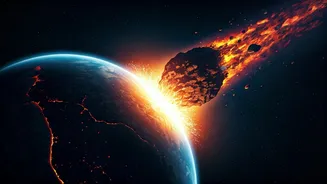
For many years, the leading theory for Venus's strange spin was a cataclysmic event, such as a massive asteroid impact early in its history. The idea was that a collision of sufficient size and at the right angle could have knocked the planet off-kilter, slowing its rotation and even flipping it over. While this is certainly plausible—a giant impact is the leading theory for Uranus’s sideways tilt—most planetary scientists now favour the atmospheric model for Venus. The atmospheric friction and thermal tide theory more elegantly explains both the slow speed and the retrograde direction. It suggests a long, gradual process rather than a single violent event. It also helps explain the delicate balance that keeps Venus locked in its current, strange rotational state.