




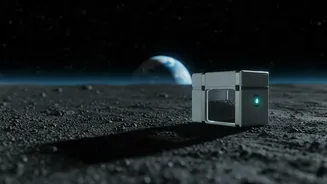
The Challenge of Long-Term Habitation
Establishing a permanent human presence on the Moon, a core goal of the Artemis program, presents a massive logistical challenge. The biggest hurdle isn't just getting there; it's staying there. Every kilogram of supplies—food, water, equipment, and especially
breathable air—must be launched from Earth, a process that is incredibly expensive and complex. For a short visit, packing supplies is feasible. But for a long-term research base or a future settlement, relying solely on resupply missions from Earth is unsustainable. To truly live on the Moon, future explorers must learn to use the resources already there. This concept, known as in-situ resource utilization (ISRU), is the key to unlocking a sustainable future in space, and NASA is making it a top priority.
Finding Air in a World Without It
The Moon has no atmosphere, but that doesn't mean it lacks oxygen. In fact, the lunar surface is surprisingly rich in it. The gray dust and rock covering the Moon, called regolith, is made of about 45% oxygen by weight. The catch is that this oxygen is chemically bonded with metals and minerals like silicon, aluminum, and iron to form oxides. It's locked inside the rock, not floating freely as a gas. The challenge for scientists has been to develop a reliable and efficient way to break these strong chemical bonds and release the oxygen. Successfully doing so would provide a virtually limitless supply of breathable air for astronaut habitats and life support systems.
Cooking Oxygen from Moon Dust
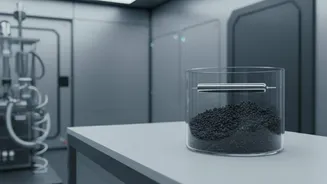
NASA and its commercial partners are exploring several methods to extract this trapped oxygen. One of the most promising is carbothermal reduction. In recent tests for a project called the Carbothermal Reduction Demonstration (CaRD), engineers used a powerful solar concentrator to focus sunlight and heat simulated lunar soil to extreme temperatures, over 1,600 degrees Celsius, inside a specialized reactor. This intense heat, sometimes combined with a reactant like methane or carbon, causes the metal oxides to break down. The process releases the oxygen, initially in the form of carbon monoxide, which can then be converted into pure, breathable O2. Recent integrated prototype tests have successfully demonstrated this process in a vacuum chamber that simulates the harsh lunar environment, confirming that the chemistry works as predicted and bringing the technology a major step closer to being ready for the Moon.
More Than Just Breathing
While providing breathable air is a primary goal, the implications of lunar oxygen production are far broader. Oxygen is not just for life support; it's also a critical component of rocket fuel. Most rocket engines use liquid oxygen (LOX) as an oxidizer to burn their fuel. The ability to manufacture LOX on the Moon would effectively turn our celestial neighbor into a refueling station for deep space missions. Rockets leaving Earth for Mars could launch with less propellant, stop at the Moon to top up their tanks, and then continue their journey. This dramatically reduces the mass and cost of missions farther into our solar system, making ambitious goals like human exploration of Mars much more achievable.
The Path to a Lunar Economy
These advancements are not happening in a vacuum. NASA is actively funding and partnering with private companies like Sierra Space and Interlune to accelerate the development of ISRU technologies. This collaborative approach fosters innovation and helps build the foundation for a future lunar economy. By proving that essential resources like oxygen, water, and metals can be harvested and used on-site, these experiments lay the groundwork for future construction, manufacturing, and commercial activities on the Moon. The progress being made in labs today is a crucial step in transforming the Moon from a temporary outpost into a bustling hub of science and exploration, powered by its own resources.