




An Unlikely Cosmic Detective
When astronomers point advanced instruments like the James Webb Space Telescope (JWST) at distant exoplanets, they are often looking for biosignatures—tell-tale signs of life. Water is at the top of that list. Yet, many of JWST's most fascinating water
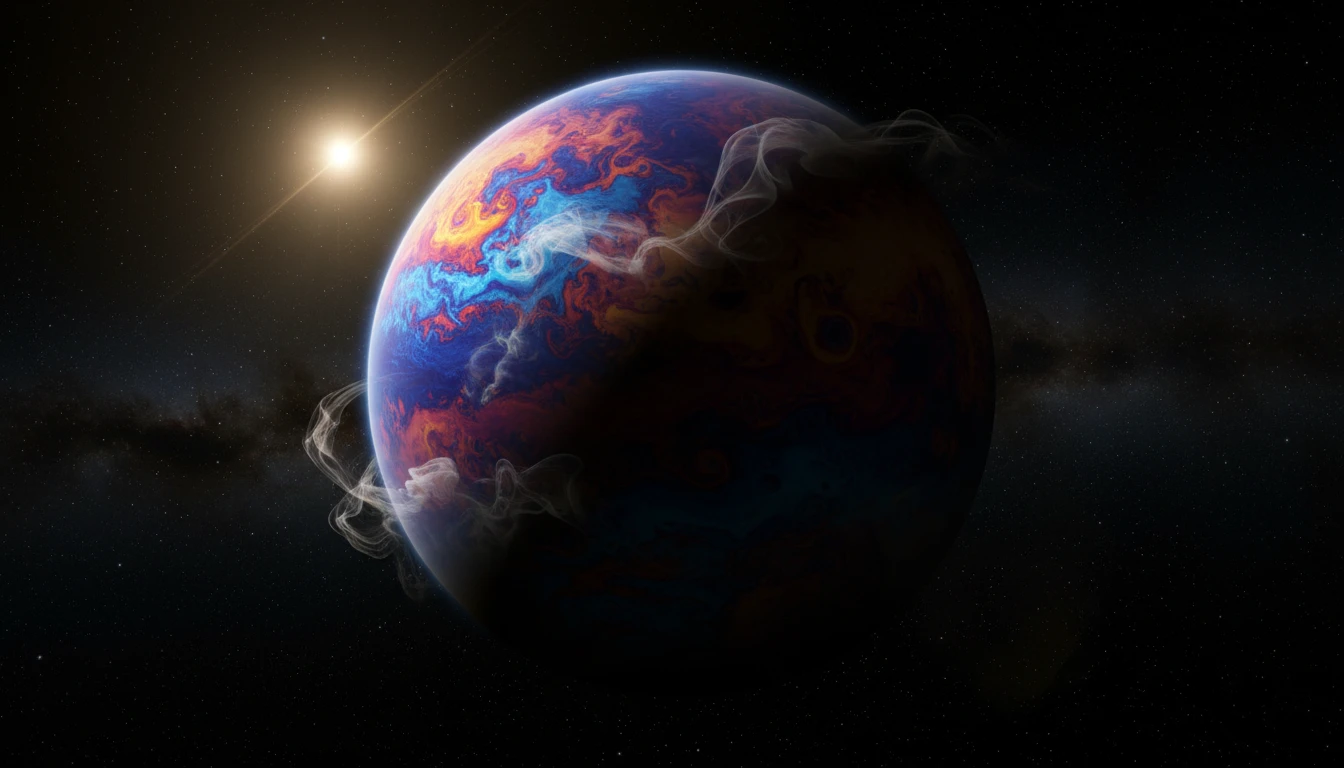
detections have been on 'hot Jupiters', massive gas giants orbiting perilously close to their stars. These worlds are entirely uninhabitable, with scorching temperatures that would tear most water molecules apart. So why get excited about finding water vapour in a place where life as we know it could never exist? The answer is that these gassy behemoths serve as a crucial blueprint for their entire solar system.
A Fossil Record of a Solar System's Birth
Planets form from a vast, rotating disk of gas and dust called a protoplanetary disk that surrounds a young star. Everything within that system, from giant planets to tiny asteroids, is built from this same shared pool of materials. Gas giants, because of their immense mass and gravity, are the most dominant objects to form and their composition acts as a fossil record of the disk's primary ingredients. By studying the atmosphere of a gas giant, scientists can effectively analyze the raw materials that were available when that planetary system was born. This includes one of the most vital ingredients for life: water.
Reading the Water Signature
Using spectroscopy, astronomers can analyze the light that passes through a gas giant's atmosphere. Different molecules absorb light at specific wavelengths, leaving a unique chemical fingerprint. Detecting the signature of water vapour, even in trace amounts, confirms that water was a significant component of the original protoplanetary disk. If a gas giant is rich in water, it strongly implies that the entire system formed from a water-rich cloud of gas and dust. This is a game-changing piece of information. Recent studies of planet-forming disks, like the one around the young star PDS 70, have confirmed the presence of water vapor in the very regions where rocky planets are expected to form.
Connecting Giants to Rocky Worlds
The key insight is that the abundance of water is not isolated to one planet. If the protoplanetary disk was full of water, then it's highly probable that any smaller, rocky planets forming in the system's habitable zone also incorporated large amounts of water during their creation. The habitable zone is the orbital band around a star where temperatures are just right for liquid water to exist on a planet's surface. Finding water on a gas giant, therefore, acts as a powerful signpost. It tells astronomers that the rocky planets in the same system had access to the necessary ingredients for oceans and, potentially, stable water cycles from the very beginning.
A Shortcut in the Search for Another Earth
There are billions of star systems in our galaxy alone. Directly observing small, rocky planets and analyzing their atmospheres is incredibly time-consuming and technically difficult. Gas giants, however, are much larger and their atmospheres are easier to study. By using gas giants as a proxy, astronomers can create a shortlist of the most promising star systems to investigate further. A system with a water-rich gas giant is a prime candidate for hosting a water-rich 'super-Earth' or other terrestrial world. This allows scientists to use their limited observation time much more efficiently, focusing on the worlds that have the highest probability of being not just rocky, but wet.