








A Signal from the Deep
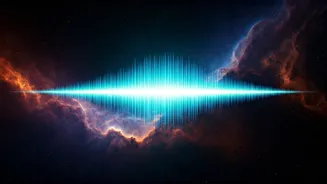
In the vast silence of space, something is sending out radio waves with unnerving regularity. Astronomers recently detected a radio transient, a burst of energy from the cosmos, that behaves unlike anything they have ever seen before. Dubbed ASKAP J1935+2148,
this celestial oddity flashes with a cycle that lasts nearly an hour, the longest ever observed for such an object. The signal was first spotted using Australia's ASKAP radio telescope, which is exceptionally good at scanning large sections of the universe and spotting unusual events. What makes this discovery so startling is not just its long cycle, but its bizarre behaviour; it sometimes emits bright, long-lasting flashes, and at other times, it sends out rapid, weaker pulses, or goes completely silent. This unpredictability within a predictable cycle is what has researchers scrambling for explanations.
The Usual Suspects: Pulsars and Magnetars
Typically, when astronomers find a repeating signal from space, their first guess is a pulsar. Pulsars are a type of neutron star—the incredibly dense, collapsed cores of massive stars—that spin at tremendous speeds, shooting out beams of radiation like a cosmic lighthouse. Their rotational periods are usually measured in seconds or even milliseconds. Another potential source for powerful radio signals are magnetars, which are a special, highly magnetized kind of neutron star. These objects have magnetic fields a quadrillion times stronger than Earth's and are known to cause some of the most powerful explosions in the universe, including Fast Radio Bursts (FRBs). FRBs are intense, millisecond-long blasts of energy that can briefly outshine entire galaxies. While some FRBs have been found to repeat, their patterns are usually irregular, not with the clockwork precision of this new signal.
An Unprecedented Pattern
The new signal from ASKAP J1935+2148 breaks the mold. Its nearly one-hour cycle is far too slow to be a typical pulsar. Current theories suggest that a neutron star spinning that slowly shouldn't be able to generate radio waves at all. This has forced astronomers to look beyond their standard models. The online science community has been buzzing with theories and discussions, sharing data and proposing new ideas in real-time. This collective, public brainstorming is a hallmark of modern astronomy, where a stunning discovery can be shared and debated globally within hours. The mystery deepens because the signal isn't just slow; it's also complex, with three distinct states: the bright flashes, the weak pulses, and total quiet. This variability has led scientists to believe they may have stumbled upon an entirely new class of celestial object or a new type of stellar behavior.
A New Kind of Star System?
So, if it’s not a standard pulsar or magnetar, what could it be? The leading theory is that this 'cosmic alarm clock' might be a very unusual neutron star or perhaps a white dwarf, which is the dense remnant of a smaller star like our sun. Some researchers propose it could be part of a binary system, where two stars orbit each other. In such a scenario, the interaction between the two objects—perhaps a white dwarf pulling material from a companion star—could be generating the radio emissions. The magnetic fields of the two stars could be interacting in a way that produces these strange, periodic bursts. This would be a significant finding, as most long-period radio bursts have previously been traced back to lone neutron stars.
Why This Discovery Matters
Pinpointing the source of this signal is more than just solving a cosmic riddle. Understanding the objects that create these emissions provides a unique laboratory for studying extreme physics—the behavior of matter under conditions of density and magnetism impossible to replicate on Earth. Each new type of signal offers another piece of the puzzle. Discoveries like this challenge existing theories and push the boundaries of our knowledge, forcing us to refine our understanding of how stars live and die. As telescopes become more powerful, they are revealing a universe that is far stranger and more dynamic than we ever imagined. This 'cosmic alarm clock' is a perfect example, a signal from the distant past that is setting the agenda for the future of astronomy.