








The Planet's Conveyor Belt
Imagine a massive, slow-moving river flowing through the world's oceans. This isn't science fiction; it's the global ocean circulation system, often called the 'thermohaline circulation' or the 'global conveyor belt'. This network of currents transports
heat, nutrients, and carbon around the planet. A critical part of this system is the Atlantic Meridional Overturning Circulation (AMOC), which carries warm water from the tropics northward. This process is essential for regulating weather patterns, especially in the Northern Hemisphere. It functions because of a delicate balance of water temperature and salt content (salinity). Cold, salty water is dense and heavy, causing it to sink in the polar regions, driving the deep-ocean currents that are the engine of this global system.
How Sea Ice Fuels the Engine
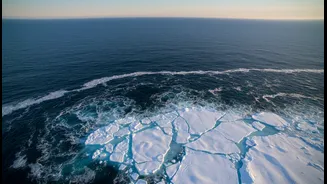
Sea ice plays a starring role in this process. When seawater freezes, it pushes out salt, leaving the remaining unfrozen water nearby much saltier and therefore denser. This super-dense, cold water then sinks to the ocean floor, particularly in the Arctic and near Antarctica, in places like the Weddell Sea. This sinking action is like a powerful suction pump, pulling warmer surface water from the equator towards the poles to replace it. In Antarctica, this process forms what is known as Antarctic Bottom Water, the coldest, densest water mass in the global ocean, which then spreads northward, ventilating the deep sea. Essentially, the formation of sea ice is a key mechanism that keeps the entire conveyor belt moving.
A System Under Threat
Now, that engine is sputtering. As global temperatures rise, two things are happening. First, the oceans are warming up. Second, ice sheets and glaciers are melting at an accelerated rate, pouring vast amounts of freshwater into the ocean. This is a double-whammy for the circulation system. Warmer water is less dense to begin with, and the influx of freshwater from melting ice reduces the ocean's overall salinity. This lighter, fresher water doesn't sink as effectively, weakening the 'pull' that drives the entire current. Recent studies have shown that the deep ocean circulation around Antarctica may have already slowed by as much as 30% since the 1990s. Scientists are concerned that this slowdown could become a 'tipping point', leading to a more abrupt collapse of circulation patterns.
Why This Matters for India
While these events are happening thousands of kilometres away, their effects are global and have serious implications for India. A slowdown of the AMOC could disrupt weather patterns worldwide, including the Asian monsoons. The Indian Summer Monsoon, which delivers about 80% of the country's annual rainfall, is a lifeline for agriculture and the economy. Studies have already started to link declining Arctic sea ice to shifts in monsoon rainfall, noting that changes in the Arctic can lead to more erratic and unpredictable monsoons in India. Researchers have found correlations between less sea ice and changes in rainfall patterns, with some parts of India receiving more rain while others experience drier conditions. Any significant, long-term disruption to these global currents adds a dangerous layer of uncertainty to the weather systems that an entire subcontinent depends on.