


The Two-Week Deep Freeze
One of the greatest hurdles for sustained lunar exploration is the night. A lunar night lasts for about 14 Earth days, and without an atmosphere to trap heat, surface temperatures plummet dramatically. During this extended darkness, temperatures can drop
to –173°C (–280°F) near the equator and even colder in the permanently shadowed regions near the poles, reaching as low as -250°C (-418°F). This unforgiving environment is lethal for standard electronics and batteries, which are typically designed to operate in Earth's much milder conditions. Most early lunar missions, including the Apollo rovers, were designed only for daytime operations and simply froze when the sun went down. Overcoming this challenge is essential for long-term science missions and establishing a permanent presence on the Moon.
Why the Cold Is a Rover-Killer
The extreme cold of the lunar night attacks a rover's vital systems in multiple ways. The primary victim is the battery. Just like a car battery on a frigid winter morning, a rover's power sources struggle in the cold. Chemical processes slow down, reducing power output, and the battery can freeze, causing permanent damage and ending the mission. To keep a rover warm using its own battery power is a huge drain; it's estimated that for every watt of power used for heating, an additional 5 kilograms of battery mass is needed. Beyond the power system, the electronics themselves are at risk. Components can become brittle and crack, and circuits designed for terrestrial temperatures can fail completely. This forces engineers to either build highly specialized, cold-tolerant electronics or, more commonly, find a way to keep the rover's core warm.
The Classic Solution: Nuclear Warmth
The most reliable method for surviving the lunar night has traditionally been the Radioisotope Heater Unit, or RHU. These small devices, about the size of a C-cell battery, contain a few grams of a radioactive material like plutonium-238. As the isotope naturally decays, it releases a steady, continuous stream of heat—about one watt per unit. This warmth keeps critical components from freezing without drawing any electrical power from the rover's batteries. China’s Chang'e landers and Yutu rovers have successfully used RHUs to wake up after multiple lunar nights. However, RHUs are expensive, rely on a limited supply of specific isotopes, and come with significant regulatory and safety considerations for launch and operation, prompting a search for effective alternatives.
A New Wave of Thermal Innovation
To avoid the complexities of nuclear materials, engineers are developing clever new ways to manage heat. One promising area is the development of advanced thermal switches. A team at Japan's Nagoya University, in collaboration with JAXA, has designed a system that combines a loop heat pipe (LHP) with a small pump. During the hot lunar day, it acts like a refrigerator, moving heat away from the electronics and releasing it through a radiator. At night, the pump activates to block the flow, effectively turning the system into a high-tech insulator that traps the rover's own residual heat with minimal energy use. Other innovations include creating an insulated "warm box" to house critical electronics, as planned for NASA's VIPER rover, and using Phase Change Materials (PCMs) that absorb heat during the day and slowly release it during the night to maintain a stable temperature.
Putting the Tech to the Test
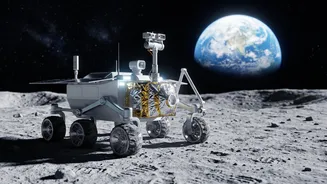
Upcoming missions are set to become showcases for these next-generation survival strategies. NASA’s Volatiles Investigating Polar Exploration Rover (VIPER) is designed to explore the Moon's south pole, where water ice may be hiding in permanently shadowed craters. Instead of hunkering down for the full night, VIPER will employ a different tactic: chasing the sun. It will strategically drive between sunlit areas to recharge its batteries and warm up before venturing into short periods of darkness. Its advanced thermal management system, developed by Advanced Cooling Technologies, uses a series of loop heat pipes and thermal control valves to meticulously manage its internal temperature, rejecting heat when active and conserving it during cold periods. This and other technologies, such as deployable vertical solar arrays that can catch sunlight for longer periods, are crucial for enabling the long-duration missions of the Artemis program.