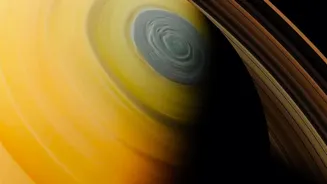






The Rings As We Knew Them
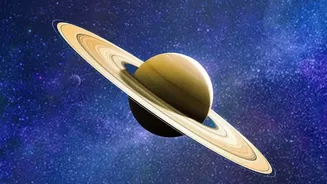
Before the Cassini-Huygens mission arrived at Saturn in 2004, our best understanding of its famous rings came from Earth-based telescopes and the brief flybys of the Voyager probes in the early 1980s. The rings were seen as a grand, ancient, and relatively
unchanging system, likely as old as the 4.5-billion-year-old planet itself. Scientists knew of the main ring groupings—A, B, and C—and the large gaps between them, like the Cassini Division. They were thought to be composed almost entirely of water ice particles. While beautiful, the rings were seen as mostly static relics of the early solar system, a kind of planetary museum piece. The physics seemed settled: a flat, stable disc of countless particles in predictable orbit.
A Dynamic and Violent World
Cassini’s sophisticated instruments immediately began to dismantle this peaceful picture. Instead of a static system, it found the rings were a hotbed of activity. The spacecraft revealed that the rings are incredibly dynamic, a place of constant collisions and gravitational jostling. Far from being perfectly flat, special viewing angles during Saturn's equinox showed gigantic vertical structures—piles and ridges of icy material towering up to 2.5 kilometres above the main ring plane. These structures, sometimes called 'straw', are often caused by the gravitational pull of nearby moons, which drag material up out of the otherwise razor-thin plane. Cassini showed that the rings were not a museum, but a live and violent laboratory.
The Propeller Revolution
One of Cassini's most profound discoveries was of features nicknamed 'propellers'. These are small, S-shaped disturbances in the rings caused by unseen moonlets, each only about a kilometre across. These moonlets are too small to clear a full gap in the rings like larger moons do. Instead, their gravity kicks up nearby particles, creating a wake in front of and behind them as they orbit, forming the propeller shape. Cassini tracked some of these propellers for years, observing their movement and evolution. This was a revolutionary finding because it demonstrated that the rings are a model for how planets form. These propellers are like miniature solar systems, showing how small bodies aggregate material and interact with the disc around them, offering a direct glimpse into the processes that built our own planets billions of years ago.
A Question of Youth
Perhaps the most paradigm-shifting discovery from Cassini concerned the rings' age. The long-held assumption was that the rings were ancient. However, during its 'Grand Finale' orbits, where the probe dove between the planet and the rings, it was able to precisely measure the rings' mass. Scientists found the rings were far less massive than previously thought. By combining this low mass with the measured rate at which interplanetary dust 'pollutes' and darkens the pristine ice of the rings, researchers came to a startling conclusion: the rings are not ancient at all. The data strongly suggests they are remarkably young, likely forming only 10 million to 400 million years ago. This means they may have appeared during the time of the dinosaurs on Earth, a cosmic blink of an eye compared to Saturn's 4.5-billion-year lifespan.
A System of Creation and Loss
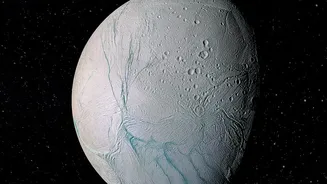
Cassini also transformed our understanding of how rings are created and sustained. It provided direct proof that Saturn's diffuse E Ring is actively being supplied by icy plumes erupting from the moon Enceladus. It also revealed that tiny moons embedded within the rings act as cosmic snowplows and sculptors, carving out gaps and creating intricate wave patterns. Some moons, like Pan and Daphnis, have accumulated ring material around their equators, giving them a distinctive 'ravioli' or 'flying saucer' shape. At the same time, Cassini detected a constant 'ring rain' of particles falling from the inner rings into Saturn's atmosphere, suggesting that the rings are actively losing mass and may eventually disappear in another 100 million years.