






A Journey of a Billion Miles
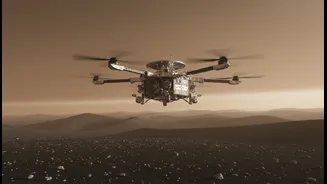
The Dragonfly mission is one of NASA's most ambitious yet. Scheduled to launch aboard a SpaceX Falcon Heavy rocket in July 2028, the rotorcraft will begin a multi-year journey across the solar system. Its destination is Titan, a moon larger than the planet
Mercury, wrapped in a thick, nitrogen-rich atmosphere. After its arrival in 2034, Dragonfly will become the first powered, controlled aircraft to fly on any world other than Earth. Its goal is to search for the chemical building blocks of life in a place that resembles a frozen, primordial version of our own planet.
Built for Brutality
Before it can even begin its scientific work, Dragonfly has to survive. The first challenge is the launch itself—the violent shaking and immense forces of blasting off from Earth. Then comes the six-year cruise through the vacuum of space. To protect the sophisticated craft, it travels inside a specially designed cruise stage and aeroshell. This protective capsule includes a heat shield that has been rigorously tested to withstand temperatures of nearly 2,500 degrees Celsius, ensuring the rotorcraft survives the fiery entry into Titan's atmosphere. During its descent, which will last almost two hours, a series of parachutes will slow the craft before it is released to fly under its own power to a safe landing zone.
An Alien World of Extremes
Titan is a world of breathtaking strangeness. Its atmosphere is four times denser than Earth's, but its surface temperature averages a frigid minus 179 degrees Celsius. Rivers, lakes, and seas of liquid methane and ethane carve its surface, and dunes of frozen organic sand stretch across its equator. While these conditions are hostile, the dense atmosphere and low gravity—just one-seventh of Earth's—actually make it an ideal place to fly. This unique combination allows a heavy, car-sized vehicle like Dragonfly to achieve flight with significantly less power than it would need on Earth.
A Nuclear-Powered Leapfrog
Dragonfly is designed as a highly mobile explorer. It’s an octocopter, meaning it has eight rotors, providing redundancy and stability. Instead of solar panels, which would be useless under Titan's hazy sky, it relies on a Multi-Mission Radioisotope Thermoelectric Generator (MMRTG). This nuclear power source, similar to those used on the Mars rovers, generates electricity from the natural decay of plutonium, allowing Dragonfly to operate and recharge its batteries during the long, eight-Earth-day Titan nights. This power allows it to fly from one location to another, covering several kilometers in a single hop and exploring dozens of sites over its multi-year mission.
The Search for Life's Ingredients
Dragonfly is not looking for life itself, but for the complex organic chemistry that may precede it. To do this, it is equipped with a suite of sophisticated instruments. The Dragonfly Mass Spectrometer (DraMS) will analyze the chemical composition of samples collected by the Drill for Acquisition of Complex Organics (DrACO). A gamma-ray and neutron spectrometer will determine the elemental makeup of the ground beneath the lander, while a geophysics and meteorology package will monitor weather and potential 'Titanquakes'. The mission's primary target is the Selk impact crater, a location where scientists believe liquid water, energy from the impact, and rich organic materials may have mixed in the past, potentially creating a habitable environment.