




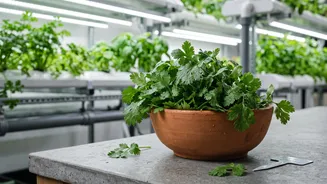
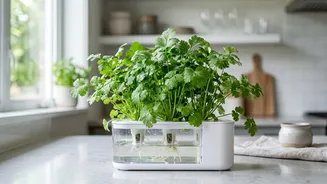

Growing coriander indoors promises a fresh supply of a kitchen essential. In hydroponics, success isn't in the soil, but in the water. A perfectly balanced nutrient solution is the secret to unlocking continuous, flavourful harvests.
Why Nutrient Balance is Critical
In a traditional garden,
soil provides a complex, buffered source of minerals for plants. In hydroponics, the grower is fully responsible for providing everything the plant needs. This gives you incredible control, but it also means the nutrient solution must be complete and balanced. For a leafy herb like coriander, the goal is to encourage lush foliage, not flowers or fruit. An imbalanced solution can lead to poor growth, a bitter taste, or cause the plant to 'bolt' prematurely—that is, flower and go to seed, ending your harvest.
The Core Macronutrients: N-P-K
Fertiliser labels always feature three numbers, known as the N-P-K ratio. These represent the primary macronutrients: Nitrogen (N), Phosphorus (P), and Potassium (K). For leafy herbs like coriander, a higher nitrogen content is key. Nitrogen drives vegetative, leafy growth. A ratio of around 3-1-2 is often recommended for herbs. Unlike fruiting plants such as tomatoes, which need more phosphorus to flower, too much phosphorus can actually diminish the aromatic oils that give coriander its signature flavour. Potassium supports overall plant health, root development, and disease resistance. When choosing a pre-mixed nutrient, look for one labelled for 'leafy greens' or 'herbs'.
The Unsung Heroes: Micronutrients
While N-P-K are the headliners, a host of micronutrients are just as essential for healthy plants, albeit in much smaller quantities. These include calcium, magnesium, sulfur, iron, manganese, and zinc. Calcium is vital for cell wall structure and prevents issues like tip burn, where the edges of new leaves turn brown. Iron deficiency, often seen as yellowing between the veins of new leaves, is a common problem. A complete, well-formulated hydroponic nutrient will contain all of these trace elements. Many two-part (A/B) formulas separate calcium nitrate (Part A) from the other elements (Part B) to prevent them from reacting and forming insoluble solids in the concentrate. Always follow the mixing instructions carefully.
The Two Most Important Numbers: pH and EC
Even with the perfect mix of nutrients, your coriander can't use them if the conditions aren't right. This is where pH and EC come in.
pH measures the acidity or alkalinity of your solution. For most hydroponic herbs, including coriander, the ideal range is between 5.5 and 6.5. If the pH is too high or too low, certain nutrients become 'locked out' and unavailable to the plant roots, even if they are present in the water. Check and adjust your pH every few days.
EC (Electrical Conductivity) measures the total concentration, or strength, of your nutrient solution. Coriander is a relatively light feeder. The recommended EC range is generally between 1.2 and 1.8 mS/cm. Starting seedlings or young plants at the lower end of this range is a safe bet. You can gradually increase the strength if growth seems pale or slow.
Choosing Your Nutrient Solution
For beginners, the easiest and most reliable path is to use a pre-mixed liquid or powdered nutrient specifically designed for hydroponics. These come in one-part, two-part (A+B), or three part formulas. One part solutions are the simplest, but two part formulas are very common and offer a good balance of control and convenience. While creating your own solution from individual mineral salts is possible for advanced growers, it requires precision scales and a deep understanding of plant chemistry. Using a quality commercial brand eliminates guesswork and ensures your plants get a complete and balanced diet from the start.
Reading the Signs: Troubleshooting
Your plants are the best indicators of what's happening in the nutrient solution. Yellowing of older, lower leaves often points to a nitrogen deficiency. Yellowing that appears on new growth first could indicate an iron deficiency, which is often caused by a pH that is too high. Stunted growth with a dark green or purplish tint on the leaves can be a sign of phosphorus deficiency. Before adding supplements, always check your pH and EC first, as an imbalance here is the most common cause of nutrient lockout, which mimics deficiency symptoms. Regular monitoring allows you to catch and correct issues before they seriously impact your coriander crop.