







The Case for Constant Motion
The human body is built to move. When you sit for prolonged periods, you're working against its natural design. This sedentary behaviour can lead to a cascade of issues, including neck and shoulder pain, lower back discomfort, poor circulation, and increased
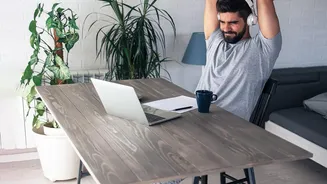
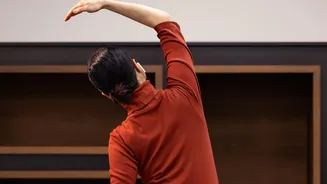
stiffness. The solution isn't necessarily an intense workout, but rather consistent, gentle movement. Taking a few minutes every hour to stretch breaks the cycle of static posture. It boosts blood flow, increases energy, improves your mood, and prevents minor aches from becoming chronic problems. Think of these movements not as an interruption, but as an essential part of maintaining your focus and well-being throughout the day.
Seated Neck Tilts and Rolls
One of the first places tension builds is in the neck and shoulders. To combat this, sit tall in your chair with your feet flat on the floor. Slowly tilt your right ear toward your right shoulder, holding for 15-30 seconds to feel a gentle stretch along the left side of your neck. Return to the center and repeat on the other side. Afterwards, gently drop your chin to your chest and slowly roll your head from side to side a few times. This simple series can be done while reading an email and provides immediate relief from screen-induced stiffness.
Shoulder Shrugs and Rolls
Hunched over a keyboard, your shoulders can start to feel tight and rounded. A quick reset is the shoulder shrug. Sit up straight and simply lift both shoulders up toward your ears, hold for a few seconds, and then release them down. Follow this with a few slow, deliberate shoulder rolls: roll them upwards, then back and down, squeezing your shoulder blades together. Then, reverse the direction, rolling them forward. This helps release tension in the upper trapezius muscles and resets your posture without anyone noticing.
Subtle Seated Spinal Twist
Your spine isn't meant to be held in one rigid position all day. A gentle twist can help maintain its flexibility. Sit upright at the edge of your chair. While keeping your hips facing forward, gently twist your upper body to the right, placing your left hand on your right knee for a light leverage. You can use your right hand to hold the back of the chair. Exhale as you deepen the twist, looking over your right shoulder. Hold for a few deep breaths, then slowly return to the center and repeat on the left side. This movement helps decompress the vertebrae and stimulates circulation.
Seated Cat-Cow Stretch
This classic yoga pose can be adapted for your chair to mobilize your spine. Sit with your hands on your knees and feet flat on the floor. On an inhale, arch your back, lift your chest, and look slightly forward, drawing your shoulder blades together (Cow Pose). On your exhale, round your spine, tuck your chin to your chest, and gently pull your navel towards your spine (Cat Pose). Alternate between these two positions for 5-10 rounds, syncing the movement with your breath. It’s a discreet way to relieve back tension.
Essential Wrist and Finger Stretches
Constant typing and mouse use can lead to repetitive strain in your hands and wrists. To counteract this, extend one arm in front of you, palm facing down. Gently bend your wrist so your fingers point toward the floor. Use your other hand to apply light pressure, pulling your fingers toward you until you feel a stretch. Hold for 15-30 seconds, then switch hands. Afterwards, make a tight fist and hold for a few seconds, then open your hand and spread your fingers as wide as possible. Repeat this several times to improve circulation and dexterity.
Making Hourly Mobility a Habit
The most effective routine is one you can stick with. The key is to make these movements a non-negotiable part of your workday. Set a simple, recurring alarm on your phone or computer for every 30 to 60 minutes. When it goes off, don't dismiss it. Pick one or two stretches from this list and take the 90 seconds to do them. You don't need to do the full routine every hour. By linking the habit to an existing cue (the top of the hour) and keeping it short, you are more likely to build a sustainable practice that will pay dividends for your physical and mental health.