







The Blueprint from Low Earth Orbit
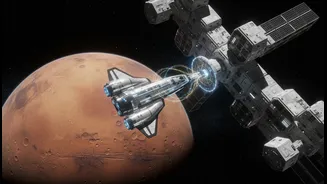
For over a decade, NASA has successfully used a public-private partnership model to service the International Space Station (ISS). Programs like Commercial Cargo and Commercial Crew outsourced the transportation of supplies and astronauts to companies
like SpaceX and Northrop Grumman. Instead of owning and operating the vehicles, NASA bought services on a fixed-price basis. This strategy stimulated a competitive commercial market, drove down launch costs, and allowed NASA to focus its resources on deep-space exploration and science. The results have been transformative, with SpaceX's reusable Falcon 9 rockets dramatically lowering the cost of reaching orbit. The success of these programs, along with the Commercial Lunar Payload Services (CLPS) initiative for the Moon, created a powerful blueprint that NASA is now looking to apply to a far more challenging destination.
A New Testbed for Mars
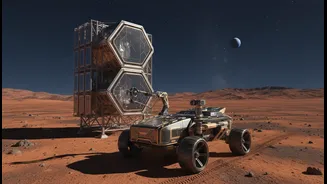
This new approach is already taking shape. In mid-2026, NASA announced a partnership with Relativity Space for a 2028 mission to Mars. Under the agreement, NASA will provide the scientific instruments for a payload called Aeolus, designed to study the Martian atmosphere. Relativity Space, in turn, is responsible for providing the rocket, the spacecraft, and managing the interplanetary flight and mission operations. This marks a significant shift, treating a Mars mission like a commercial delivery service. The goal is to see if this model can deliver more science, more frequently, by offloading the immense cost and complexity of launch and transit to the private sector. NASA Administrator Jared Isaacman called these partnerships a "force multiplier for science." The agency has also initiated studies for a potential Commercial Mars Payload Services (CMPS) program, modeled after its lunar counterpart, to further explore commercial options for landing and imaging services on the Red Planet.
The Perils of Price Tag Optimism
Herein lies the central challenge. The headline's skepticism about "commercial-cost optimism" is well-founded. Mars is an exponentially harder and more expensive destination than Earth orbit or even the Moon. The journey is longer, the communications are delayed, and the environment is brutally unforgiving. While companies like SpaceX project Starship launch costs as low as $10 million, these figures are aspirational and do not include the massive research and development overhead or the specific costs of a multi-month interplanetary voyage. Critics of privatization worry about a number of issues: the potential for monopolies, the risk of a high-profile private failure damaging public support for all space exploration, and the question of whether profit motives align with the painstaking, long-term nature of scientific discovery. There's a risk that initial low-ball bids could balloon in cost once the complexities of a Mars mission become fully apparent, a common issue in large aerospace projects.
Why Mars Is a Different Beast
Unlike delivering cargo to the ISS, there is currently no existing market or infrastructure at Mars. A company cannot easily sell excess capacity on a Mars-bound spacecraft to other customers to diffuse costs. The entire business case rests on NASA and other government agencies being reliable anchor tenants for the foreseeable future. Furthermore, planetary protection protocols—ensuring that Earth microbes do not contaminate Mars and vice versa—add a layer of complexity and cost that commercial ventures have not yet had to manage on this scale. While the lunar CLPS program serves as a valuable test, it has also faced its own challenges, with both failures and partial successes among its first missions, highlighting the difficulty of relying on new commercial systems for high-stakes science.
A New Frontier for Science
Despite the risks, the potential upside for planetary science is enormous. Traditionally, a Mars mission is a once-in-a-decade, multi-billion-dollar endeavor for NASA. If private companies can reliably and affordably deliver payloads, it could enable a continuous flow of smaller, more focused science missions. This would allow scientists to gather more data on everything from Martian weather—critical for planning future human missions—to geology and the search for past life. It would allow NASA to dedicate its budget to what it does best: developing world-class scientific instruments and analyzing the data they return. The private sector's incentive to innovate and reduce costs could accelerate the pace of exploration, creating a symbiotic relationship where NASA's scientific goals create a market that allows commercial capabilities to mature.