


What Are Super-Earths?
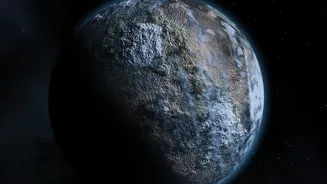
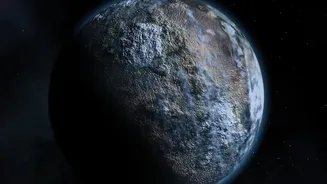
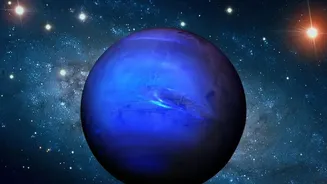
The term 'super-Earth' might sound like a planetary superhero, but it's a simple classification for a type of planet we don't have in our own solar system. These are worlds with a mass higher than Earth's but substantially less than our ice giants, Uranus
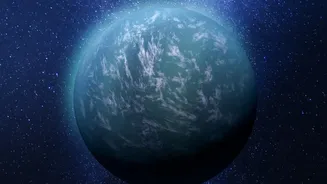
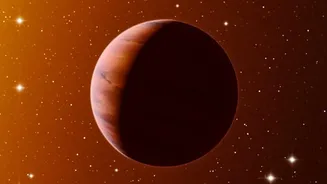
and Neptune. They can be rocky like Earth, gaseous like mini-Neptunes, or something else entirely, like a world covered in a deep ocean. Interestingly, super-Earths appear to be one of the most common types of planets in our galaxy, which makes them prime targets for astronomers. Recent JWST studies have focused on several of these, including the well-known K2-18 b and the scorching-hot 55 Cancri e, to peel back the layers of their atmospheres.
Glimpses into Alien Atmospheres
The JWST doesn't see water directly. Instead, it uses a technique called spectroscopy. When a planet passes in front of its star, the starlight filters through the planet's atmosphere. Different molecules absorb light at specific wavelengths, leaving a unique 'fingerprint' that the telescope can read. The recent findings show the unmistakable signature of water vapour in the atmospheres of some of these worlds. For a planet like 55 Cancri e, which is so hot its surface is likely molten lava, discovering it has any atmosphere at all is a huge breakthrough. Scientists were astounded to find that the planet, blasted by intense radiation from its star, can hold onto a gaseous envelope, possibly rich in carbon monoxide or carbon dioxide.
The Telescope Behind the Tech
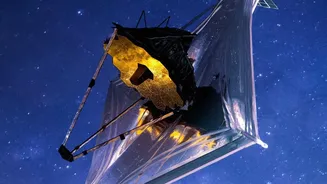
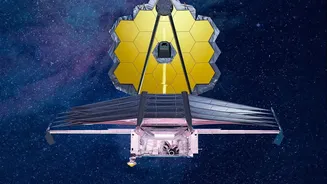
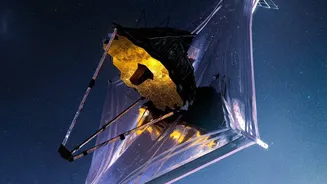
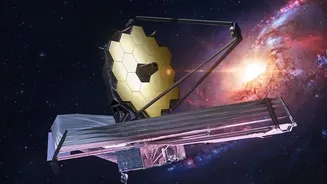
This discovery is a massive return on investment for the James Webb Space Telescope, a collaboration between NASA, the European Space Agency, and the Canadian Space Agency. Launched in 2021, its advanced infrared instruments are far more sensitive than those of its predecessor, the Hubble Space Telescope. This allows it to detect faint signals from exoplanet atmospheres with unprecedented detail. In fact, for a planet like 55 Cancri e, temperature readings from JWST were the first clue. The dayside was cooler than expected for a bare rock, suggesting an atmosphere was distributing heat from the dayside to the nightside. This level of precision is enabling what scientists are calling a new era of exoplanet science, pushing the frontiers of what we can learn about these distant worlds.
Why This Isn't Proof of Alien Life (Yet)
It's crucial to put these findings in context. Detecting water vapour—a gas—is not the same as finding liquid water oceans. And even the presence of liquid water doesn't automatically mean life. Many of the super-Earths studied so far are inhospitable. 55 Cancri e, for instance, has surface temperatures hot enough to melt rock, around 1540 degrees Celsius. K2-18 b, which orbits in its star's habitable zone, is more promising, but scientists are still debating whether it's a true 'Hycean' (hydrogen-ocean) world or more of a gassy mini-Neptune. These discoveries are not about finding aliens tomorrow; they are about validating our methods and proving that we now have the technology to identify the building blocks of habitability across the galaxy.
The Next Frontier in Cosmic Exploration
So, what's next? Each discovery provides a new piece of the puzzle. Scientists will continue to point the JWST at these and other super-Earths to gather more detailed data. They'll look to quantify the amount of water and search for other key molecules like methane, ammonia, and even biosignatures—gases that could hint at biological processes. One recent, though heavily debated, finding on K2-18 b was the potential presence of dimethyl sulfide (DMS), a substance on Earth primarily produced by marine life. While this is far from confirmed, it shows the direction this research is heading. The goal is to move from simply detecting atmospheres to characterizing them in enough detail to determine if a planet could, in theory, support life.