


Artemis: Humanity’s Return to the Moon
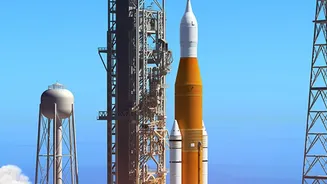
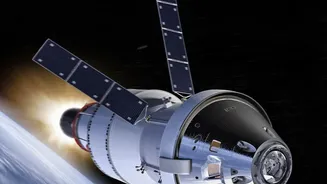
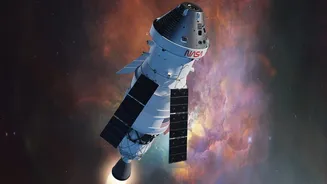
The days of watching grainy Apollo footage are over; a new generation is going back to the Moon, and this time, to stay. NASA’s Artemis program is a monumental effort to establish a sustainable human presence on the lunar surface. Following a successful
uncrewed test flight, Artemis II took four astronauts on a trip around the Moon in April 2026, marking the first crewed voyage of the Orion spacecraft. For India, this mission is especially relevant. NASA has officially invited ISRO to partner in its Moon Base program, building on the success of collaborations like the NISAR satellite which launched in 2025. This invitation recognises India's own lunar expertise, demonstrated by Chandrayaan-3's historic landing at the South Pole. As NASA plans its first crewed lunar landing since 1972 with Artemis III, targeted for 2028, the potential for Indian involvement in building a permanent lunar outpost makes this a critical development to follow.
Europa Clipper: The Search for Alien Oceans
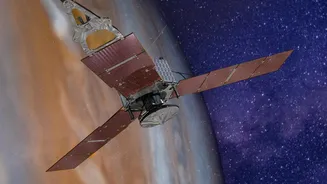
Is there life beyond Earth? NASA's Europa Clipper mission is designed to tackle one of science's most profound questions. Launched in October 2024, the spacecraft is on a long journey to Jupiter's icy moon, Europa, which is believed to hide a vast liquid water ocean beneath its frozen shell. By August 2026, the spacecraft is well on its way, preparing for a Mars gravity assist in 2025 and a final Earth gravity assist in late 2026 before heading to the outer solar system. Upon its arrival at Jupiter in 2030, Europa Clipper will perform dozens of close flybys, using its advanced instruments to measure the thickness of the ice, study the ocean's properties, and even scan for water plumes erupting into space. While ISRO focuses on missions like Gaganyaan and its own planetary exploration, Europa Clipper represents the global scientific quest for habitable worlds—a mission whose discoveries could redefine our place in the universe.
Dragonfly: A Nuclear-Powered Drone on Titan
Perhaps one of the most futuristic missions ever conceived, Dragonfly will send a car-sized, nuclear-powered drone to explore Saturn’s largest moon, Titan. Scheduled for launch in July 2028, this rotorcraft will fly through Titan's dense, nitrogen-rich atmosphere, hopping from one scientifically interesting location to another. Titan is a world with rivers, lakes, and seas of liquid methane and ethane. Its complex, carbon-rich chemistry is thought to be similar to that of early Earth, making it a prime target for studying the building blocks of life. The mission passed its critical design review and has been undergoing significant structural testing, with teams integrating its complex systems. For Indian space enthusiasts, Dragonfly is a glimpse into the next frontier of robotic exploration. While ISRO's rovers have explored the Moon, Dragonfly's ability to fly across an alien moon represents a revolutionary leap in our ability to explore other worlds.
Mars Sample Return: A Challenging Quest
Bringing a piece of another planet back to Earth is one of the ultimate goals of space exploration. The Mars Sample Return (MSR) mission, a joint effort with the European Space Agency, aims to do just that. NASA's Perseverance rover has been drilling and collecting rock and soil samples on Mars since 2021, storing them in special tubes for a future pickup. However, the mission has faced significant challenges. As of early 2026, budgetary issues in the U.S. have led to a major reassessment of the mission's architecture, effectively putting the original plan on hold. Despite the setbacks, the scientific imperative to study pristine Martian samples in labs on Earth remains incredibly high. For India, which celebrated its own successful Mars Orbiter Mission (Mangalyaan), the saga of MSR highlights the immense technical and financial hurdles of interplanetary science. Watching how NASA and its partners navigate this challenge will be a lesson in the realities of ambitious space exploration.