


The Classic Tale of Cosmic Chaos
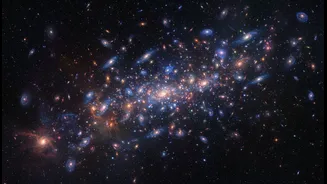
The standard story of galaxy formation has always been a dramatic one. In the aftermath of the Big Bang, the universe was a dark, turbulent place. Gravity slowly pulled together vast clouds of gas and dark matter. These clumps smashed into each other
in violent mergers, triggering chaotic bursts of star formation. The prevailing theory held that it took billions of years for this cosmic mosh pit to settle down, eventually forming the majestic, well-behaved spiral and elliptical galaxies we see in our cosmic neighbourhood today, like our own Milky Way. Early galaxies, therefore, were expected to be messy, clumpy, and totally disordered. Recent large-scale studies have confirmed that many were indeed turbulent systems. However, this is no longer the full story.
An Unexpected Glimpse of Calm
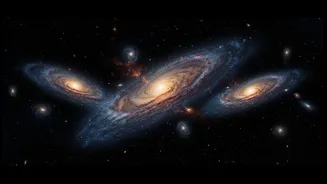
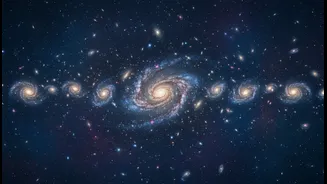
The narrative began to shift with puzzling discoveries of galaxies that simply shouldn't have existed. Astronomers found examples of well-ordered, rotating disk galaxies from a time when the universe was less than a billion years old. These were like finding a fully grown adult in a cosmic nursery. They were considered rare outliers, but they planted a seed of doubt: could galaxies mature much faster than our models predicted? The James Webb Space Telescope (JWST) has turned these trickles of doubt into a flood of new evidence, showing that 'order' in the early universe appeared in several surprising forms.
Complex Structures From the Inside Out
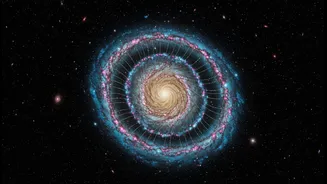
One of the most recent and striking discoveries comes from astronomers who found a distant galaxy with a complex internal structure, seen as it was over nine billion years ago. At its heart lies a dense, star-forming region called a 'nuclear disc,' being fed by a larger bar of stars. Such features were thought to be hallmarks of mature, modern galaxies. Finding one so early suggests that the internal machinery of galaxy-building was already in place just a few billion years after the Big Bang. Instead of a chaotic free-for-all, it seems some galaxies were already building themselves in an organised, efficient manner from the inside out.
The Paradox of the Galaxy That Forgot to Spin
In another cosmic puzzle, astronomers using the JWST found something just as strange: a massive early galaxy that wasn't spinning at all. The fundamental physics of collapsing gas clouds dictates that galaxies should be born spinning. A galaxy without rotation is typically an ancient, 'dead' one that has undergone countless mergers over cosmic history, with the collisions cancelling out its spin. To find a galaxy that had already reached this state when the universe was less than two billion years old is a profound mystery. It suggests that the lifecycle of galaxies might be accelerated in ways we are only beginning to comprehend.
Rewriting the Cosmic Rulebook
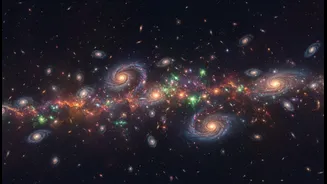
These individual discoveries are part of a larger trend. The JWST is consistently finding things in the early universe that are bigger, more massive, and more mature than they have any right to be according to the standard model of cosmology. Adding another layer of intrigue, one recent analysis of hundreds of early galaxies found a bizarre preference in their direction of rotation, hinting at a large-scale order imprinted on the universe itself. Taken together, these findings don't just add a new chapter to our textbooks; they suggest the entire book on galaxy formation needs a major revision. The engine of galaxy growth appears to be far more efficient and capable of producing sophisticated structures far earlier than once believed.