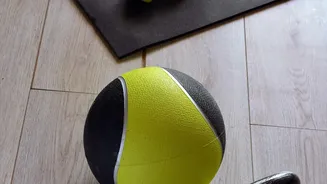






When Shilpa Shetty shares a workout, people pay attention. Her latest fitness challenge, a clever ball-juggling act while balancing on one leg, is more than just an impressive feat; it’s a masterclass in the power of balance and coordination.
The Challenge: More Than Meets the Eye
In a recent
social media post, Shilpa Shetty demonstrated a workout that looked both playful and incredibly demanding. Standing first on two feet and then on one, she juggled two small balls, dropping and catching them in a continuous rhythm. This wasn't just a simple test of hand-eye coordination; by balancing on a single leg, she turned a simple drill into a full-body exercise that engages the brain, core, and stabiliser muscles simultaneously. As Shilpa explained in her post, the goal is to get the body and brain working together, enhancing focus and control. This type of exercise, which combines physical and cognitive tasks, is a powerful way to improve functional fitness for people of all ages.
The Science of Stability: What is Proprioception?
At the heart of Shilpa's challenge is a concept called proprioception. Think of it as your body's 'sixth sense'. It’s the unconscious awareness of where your body parts are in space without having to look at them. This sense is managed by receptors in your muscles, joints, and tendons that constantly send signals to your brain about your body's position and movement. When you stand on an unstable surface, like one leg or a stability ball, these receptors fire off messages at high speed, forcing your muscles to make tiny, rapid adjustments to keep you from falling. Training your proprioception through balance exercises strengthens this mind-body connection, leading to better coordination, quicker reflexes, and enhanced stability in all your movements.
From Proximal Stability to Distal Mobility
There's a key principle in biomechanics known as 'proximal stability for distal mobility'. In simple terms, it means you need a strong, stable core to allow your limbs (arms and legs) to move freely and powerfully. Exercises like the one Shilpa demonstrated force you to engage your deep core muscles to maintain balance. This stable core acts as an anchor, allowing for more precise and controlled movements of the hands and feet. When your core is stable, the power generated from your legs can be transferred efficiently through your trunk to your arms for tasks like throwing a ball or swinging a racquet. Without that central stability, energy is lost, and movements become less coordinated and more injury-prone.
Why Better Balance Means Better Ball Control
The link between balance and ball control is direct. Whether you're playing cricket, football, or tennis, your ability to control a ball depends on a stable base. A strong core and well trained sense of balance allow you to make adjustments on the fly, whether you're lunging to return a serve or kicking a ball while running. By improving your body's ability to stabilise itself, you free up your limbs to perform the skilled action required. Your brain doesn't have to work as hard to keep you upright, so it can dedicate more resources to tracking the ball and coordinating the precise muscle contractions needed to intercept or strike it effectively. This improved neuromuscular control not only enhances performance but also significantly reduces the risk of common injuries like ankle sprains and knee ligament tears.
Easy Ways to Start Training Your Balance
You don’t need to be a celebrity fitness icon to reap the benefits of balance training. You can start building better proprioception and core stability at home with simple exercises. Begin by standing on one leg for 30 seconds at a time, then switch. To make it harder, try closing your eyes or standing on a pillow. You can also practice walking heel-to-toe along a straight line. As you get more comfortable, you can incorporate dynamic movements, like singlendegree Romanian deadlifts without weights, or even try juggling a single soft ball while standing on one foot. The key is consistency. Integrating these small challenges into your routine can lead to significant improvements in your overall stability and control.