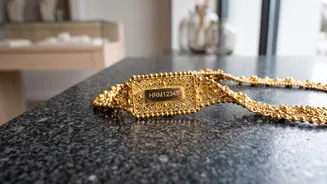








Buying gold jewellery in India is a cherished tradition and a significant investment. Now, a crucial step can protect your purchase like never before: verifying the Hallmark Unique Identification (HUID) number. Here is your guide to doing it right.
What Is a HUID Number?
A Hallmark
Unique Identification (HUID) number is a six-character alphanumeric code, like 'AB1234', that is laser-engraved onto every individual piece of hallmarked gold jewellery sold in India. Since April 1, 2023, it has been mandatory for registered jewellers to sell only hallmarked gold jewellery with a HUID. This system was introduced by the Bureau of Indian Standards (BIS) to enhance transparency and ensure that consumers get the purity of gold they pay for. The HUID system gives every single piece of jewellery its own unique identity, which is traceable and verifiable. This is a major upgrade from the older hallmarking system, which was not unique to each item.
The Three Marks of Authenticity
When you inspect a piece of new gold jewellery, you should find three specific marks, which together form the complete BIS hallmark. First is the triangular BIS logo, which confirms the certification is from the Bureau of Indian Standards. Second is the purity and fineness grade, such as '22K916' (for 22-carat gold, which is 91.6% pure) or '18K750' (for 18-carat gold). The third and most critical mark for verification is the six-character HUID code. Jewellery made before July 2021 might have an older, four-part hallmark without a HUID, which is still valid if you already own it, but jewellers cannot sell such pieces as new anymore.
How to Verify Your Jewellery's HUID
Verifying the HUID is a simple process that you can and should do at the jeweller's counter before finalising your purchase. All you need is your smartphone. First, download the official 'BIS CARE' app from the Google Play Store or Apple App Store. Be sure to download the app published by BIS to avoid fakes. Once installed, open the app and select the 'Verify HUID' option on the home screen. Ask the jeweller to show you the HUID code on the jewellery; you might need a magnifying glass as it is often very small. Carefully enter this six-character code into the app and tap 'Search'.
Understanding the Verification Results
If the HUID is genuine, the BIS CARE app will display a set of details linked to that specific piece of jewellery. This includes the jeweller who had the item hallmarked, the Assaying and Hallmarking Centre where it was tested, the date of hallmarking, the type of article (e.g., 'ring', 'bangle'), and its purity. Your job is to cross-reference this information. Does the purity shown in the app (e.g., 22K916) match what is stamped on the item and what the jeweller has told you? Does the item type match what you are holding? This instant check provides a powerful layer of assurance that the hallmark is legitimate and the information is accurate.
What If the Details Don't Match?
If you enter the HUID and the app shows 'record not found', first double-check the code for typos. If it still doesn't work, or if the details displayed do not match the jewellery—for example, the app shows 18K purity for a piece sold as 22K—it is a major red flag. Do not proceed with the purchase. You should immediately bring the discrepancy to the jeweller's attention. If their explanation is not satisfactory, you have the right to file a formal complaint. You can do this directly through the 'Complaints' section of the BIS CARE app or by calling the BIS helpline. Always ensure the HUID for each item is also mentioned on your final purchase bill, as this is crucial proof for any future disputes.