




A Messenger to an Icy World
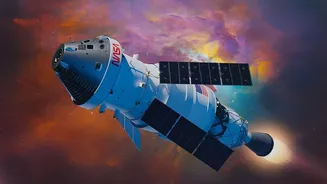
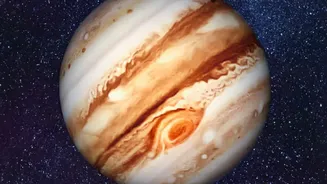
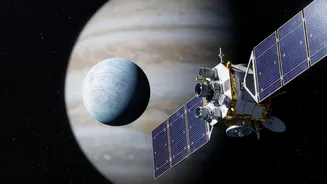
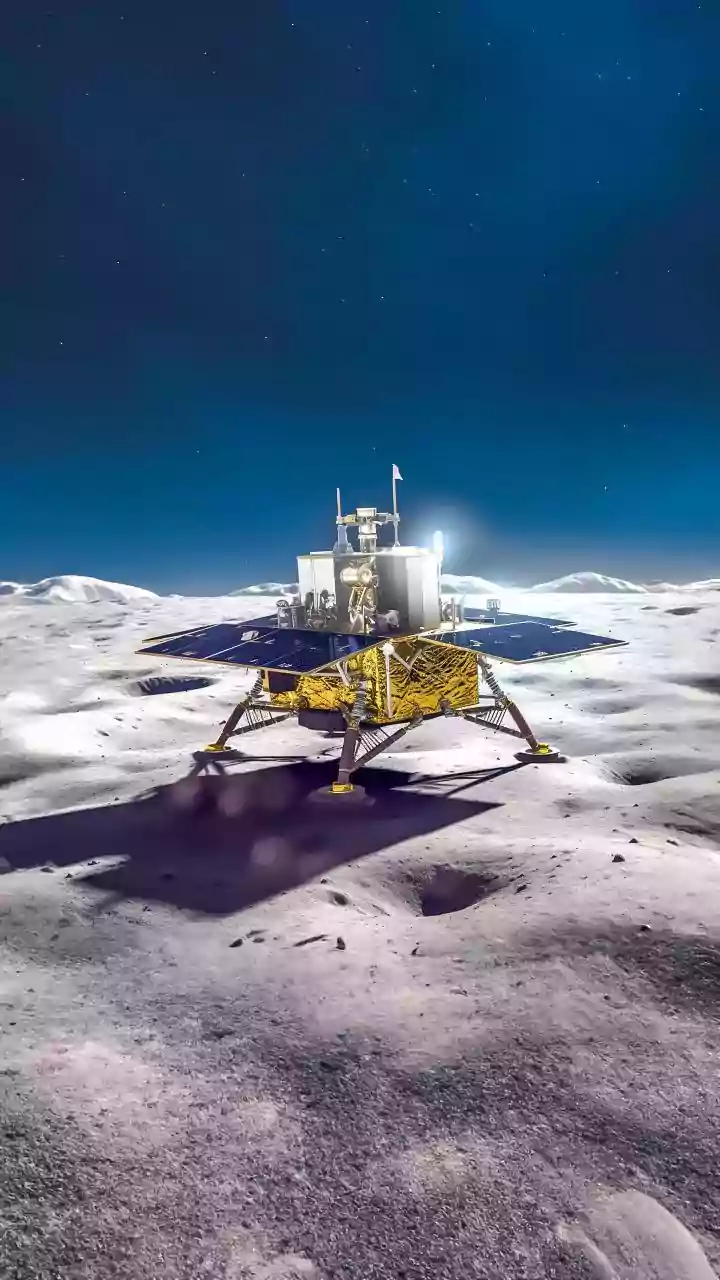
Launched in October 2024, the Europa Clipper is NASA's largest-ever interplanetary spacecraft, with solar arrays that span more than 30 meters, longer than a basketball court. This massive probe is on a multi-billion-kilometer journey to the Jupiter system.
To get there, it’s taking a scenic route, using the gravity of other planets to build up speed. After a successful flyby of Mars in March 2025, the spacecraft is currently heading back toward our home planet. In December 2026, it will swing by Earth for a final gravity assist that will slingshot it on a direct path to Jupiter, where it is scheduled to arrive in April 2030.
The Grand Mystery of Europa
Europa, a moon of Jupiter slightly smaller than Earth’s own, is one of the most compelling destinations in our solar system. Data from previous missions, especially NASA's Galileo spacecraft in the 1990s, provided strong evidence of a global, salty liquid water ocean hidden beneath an ice crust estimated to be several kilometers thick. This ocean is thought to remain liquid due to the immense gravitational pull of Jupiter, which flexes and stretches the moon, creating tidal heat in its interior. Scientists believe this hidden sea, along with potential energy sources and key chemical elements, makes Europa a prime candidate in the search for habitable environments beyond Earth.
The Tools for a Cosmic Investigation
To study a world from millions of kilometers away, Europa Clipper carries a sophisticated suite of nine scientific instruments. These tools are protected within a titanium and aluminum vault to shield them from Jupiter's intense radiation. Among them is an ice-penetrating radar called REASON, designed to measure the thickness of the ice shell and search for pockets of water or even the ocean itself. Spectrometers will analyze the chemical composition of the moon's frosty surface, while high-resolution cameras will map its geology in unprecedented detail, looking for cracks, shifts, or potential plumes of water vapor erupting into space. By studying the moon's magnetic field, another instrument will help confirm the ocean's existence, depth, and saltiness.
Searching for Habitability, Not Life
It's important to clarify that Europa Clipper is not a life-detection mission. Its primary goal is to determine if Europa has the three crucial ingredients for life as we know it: liquid water, essential chemical elements (like carbon), and a source of energy. The probe will not land or drill into the ice. Instead, it will perform nearly 50 close flybys of Europa, some as low as 25 kilometers above the surface. During these passes, it will gather data to build a comprehensive picture of the moon's potential habitability. If it finds evidence of plumes venting water from the ocean into space, it might even be able to fly through and sample them directly, essentially tasting the ocean without ever touching it. The mission's findings will help select a landing site for a potential future mission that could search for life directly.
A Long Journey Ahead
As of September 2026, Europa Clipper is continuing its 5.5-year cruise to Jupiter. Its trajectory is carefully planned to avoid the worst of Jupiter’s harsh radiation belts. Rather than orbiting Europa directly, the spacecraft will enter a long, looping orbit around Jupiter and make repeated, rapid flybys of the moon. This strategy allows the probe to gather precious data while minimizing exposure to radiation that could damage its sensitive electronics. The science phase of the mission is expected to begin in early 2031 and last for about four years. If all goes according to plan, the mission will conclude around 2034 with a controlled impact into Jupiter's largest moon, Ganymede, ensuring Europa's pristine environment remains uncontaminated. The discoveries made could fundamentally change our understanding of where life can exist in the universe.