



A Football Field in the Sky
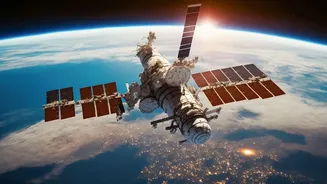
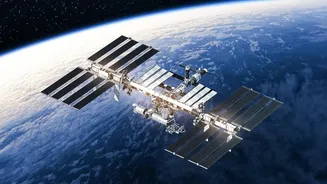
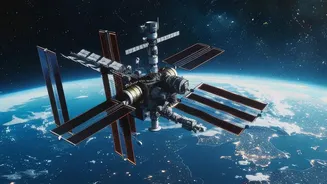
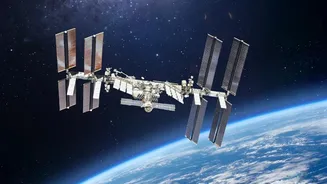
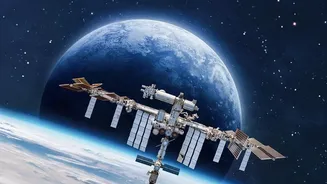
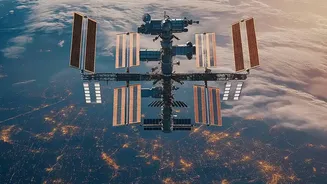
The International Space Station is a marvel of engineering and global cooperation. It's a massive orbiting laboratory, roughly the size of a football field, that zips around our planet at a staggering 28,000 kilometres per hour. Orbiting at an altitude
of about 400 kilometres, it completes a full circle of the Earth every 90 minutes. This means the astronauts on board witness 16 sunrises and sunsets every single day. The ISS is a joint project between five space agencies: NASA (USA), Roscosmos (Russia), JAXA (Japan), ESA (Europe), and CSA (Canada). Since the year 2000, it has been continuously inhabited by astronauts conducting research that is impossible to perform on Earth.
Why You Should Look Up
Spotting the ISS is a unique and surprisingly easy experience. It is the third brightest object in the night sky, after the Sun and the Moon. You don't need a telescope or binoculars; it is brightly visible to the naked eye. Watching it glide silently across the sky is a powerful reminder of human ingenuity and our drive to explore. For a few minutes, you can have a direct line of sight to the handful of humans living and working in space. It’s a moment of connection that links your spot on the ground to humanity’s outpost amongst the stars, a sight that often inspires awe in both children and adults.
Finding the Right Time and Place
The key to seeing the ISS is knowing when it will pass over your location. The best viewing opportunities occur in the hours just after sunset or before sunrise. During these twilight periods, the sky is dark on the ground, but the station, at its high altitude, is still illuminated by the Sun's rays, making it shine brightly. Because India lies well within the station's orbital path, there are frequent and excellent viewing opportunities throughout the year. The most reliable way to get precise timings for your city is to use NASA's official 'Spot The Station' service. You can visit their website, select India, and then choose your nearest city from the list to get a schedule of upcoming passes, including the exact time, duration, and direction.
What to Look For in the Sky
When you have your viewing time, head outside a few minutes early to a spot with a clear view of the sky, preferably away from tall buildings and bright city lights. The ISS will appear as a very bright, steady, white point of light moving smoothly across the sky. It does not blink or flash like an airplane; it looks more like a fast-moving star. Its speed is one of its most distinguishing features. It will cross a large patch of sky in just a few minutes before disappearing as it moves into Earth's shadow or below the horizon. The entire pass can last anywhere from a minute to over six minutes, depending on the path it takes.
Your Stargazing Toolkit: Best Apps and Websites
While NASA's Spot The Station website is the gold standard, several mobile apps can make tracking the ISS even easier by sending you alerts for upcoming passes. Apps like 'ISS Detector' and 'Satellite Tracker' are popular choices for both Android and iOS devices. Many of these apps use your phone's GPS to provide highly accurate predictions and can even use augmented reality to show you exactly where in the sky to look. For those who want more detailed information, the 'Heavens-Above' app and website is another excellent resource, providing charts and data for the ISS and many other satellites.
India's Connection to the Stars
For Indian stargazers, looking up at the ISS has taken on special significance. While Rakesh Sharma became the first Indian in space in 1984, a new generation has continued that legacy. Astronauts of Indian origin, like Sunita Williams, have spent extensive time aboard the ISS, setting records for spacewalks. More recently, Indian Air Force pilot Shubhanshu Shukla became the first Indian citizen to visit the International Space Station in 2025 as part of Axiom Mission 4. His mission, a collaboration involving ISRO, included performing experiments designed by Indian scientists, marking a proud moment for the nation's growing role in global space exploration.