







What Makes a Cloud Walk?
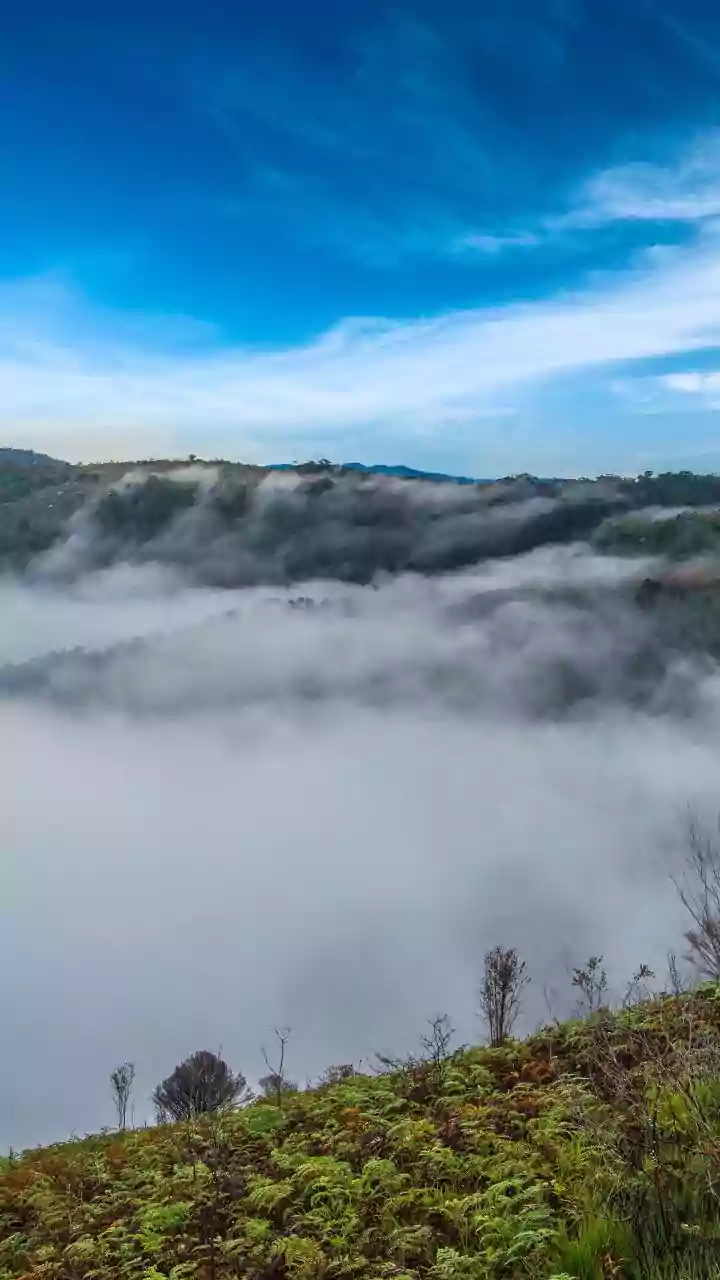
A "cloud walk" is not a formal term, but a beautiful way to describe the experience of being at an elevation where you are above the cloud cover. This often happens during a phenomenon called a temperature inversion, where a layer of warm air traps a layer of cooler,
moist air (and clouds) below it in a valley. From a high viewpoint—a mountain peak, a suspension bridge, or a high-altitude road—it looks like you are standing on the shore of a vast, white ocean. It’s a moment of profound peace and perspective, where the world below seems to fall away, leaving you in a silent, ethereal landscape. These experiences are most common during post-monsoon and winter mornings, when the air is cool and moisture is high.
Pelling Skywalk, Sikkim
Suspended near the magnificent Chenrezig statue in Pelling, Sikkim, is India’s first glass skywalk. This is perhaps the most direct way to feel like you are walking on air. The transparent floor gives you a dizzying, thrilling view of the valley plunging hundreds of feet below. When the conditions are right, usually in the early morning, the entire valley fills with clouds, and a walk on this bridge feels like a stroll into the heavens. With the snow-capped Kanchenjunga range often visible in the distance, it’s a breathtaking combination of human engineering and natural wonder. The best time to visit for clear views and potential cloud inversions is from October to February.
Nongriat's Living Root Bridges, Meghalaya
The journey to Nongriat village in Meghalaya is a cloud walk of a different kind. Here, you descend into a lush, tropical valley, often shrouded in mist and low-hanging clouds, which gives the entire trek an otherworldly feel. The destination is the famous Double Decker Living Root Bridge, a marvel of bio-engineering. Crossing these ancient, moss-covered bridges, with the river roaring below and mist swirling around you, feels like stepping into a fantasy novel. The state's name, Meghalaya, literally means "abode of clouds," and a trek here shows you why. While beautiful year-round, the post-monsoon months (September to November) offer a vibrant green landscape with plenty of atmospheric mist.
Kodaikanal's Coaker’s Walk, Tamil Nadu
For a more accessible and gentler cloud walk, Coaker’s Walk in Kodaikanal, Tamil Nadu, is a classic choice. This paved pedestrian path, about a kilometre long, is carved into the steep slopes of the Palani Hills. It offers stunning panoramic views of the plains below. On a clear day, the view is spectacular, but the real magic happens on misty mornings. The valley below often fills with a sea of clouds that slowly dissipates as the sun rises, creating a dynamic and mesmerising spectacle. It’s an easy walk suitable for all ages, making it a perfect spot for families to experience this phenomenon. Occasionally, a rare optical illusion known as the "Brocken spectre" can be seen here, where your shadow is cast onto the clouds below, surrounded by a halo-like ring of light.
Kolukkumalai, Kerala & Tamil Nadu
Perched on the border of Kerala and Tamil Nadu, Kolukkumalai is home to the highest organic tea estate in the world. Reaching it requires a bumpy jeep ride, but the reward is one of the most sublime sunrise views in South India. From the viewpoint, you look down upon a vast expanse of clouds filling the valleys of Tamil Nadu. As the sun rises, it paints the cloud sea in hues of orange, pink, and gold. It’s not a walk *on* the clouds, but a vantage point so high that you feel completely detached from the world below. The experience is raw, windy, and utterly unforgettable. The ideal time to visit is during the winter months from December to February, when the skies are clearer and the chances of seeing the "sea of clouds" are highest.