


The Balcony Gardener's Watering Dilemma
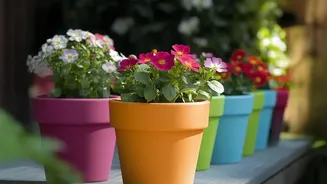
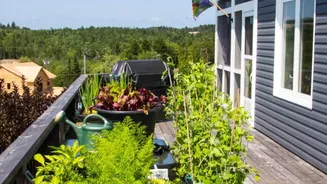
For apartment dwellers in India, a balcony garden is a cherished green escape. However, these unique microclimates present challenges. Unlike backyard gardens, container plants have limited space for their roots and depend entirely on you for water. This
confined environment makes them highly susceptible to overwatering. Factors like concrete walls retaining heat and pots having limited drainage mean that a well-intentioned watering can quickly lead to waterlogged soil. The signs of overwatering—yellowing leaves, wilting, and mushy stems—are often mistaken for signs of thirst, leading gardeners to water even more and unknowingly drown their plants. This cycle of misdiagnosis is a primary reason many urban gardening efforts fail.
What Exactly Is an IoT Soil Probe?
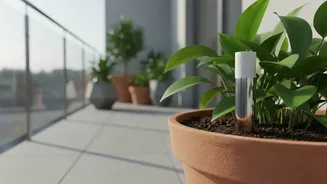
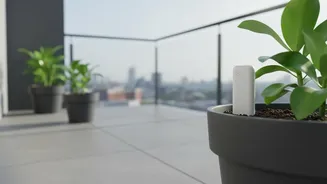
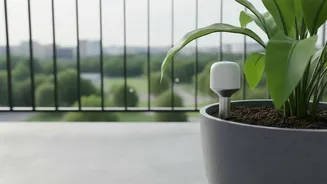
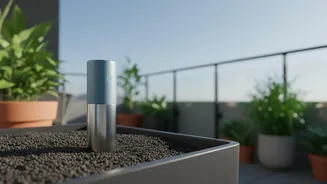
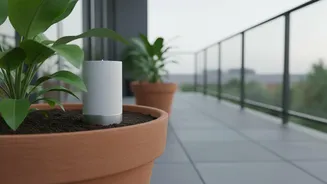
An IoT (Internet of Things) soil probe is a smart sensor you stick into the soil of your plant pot. At its core, it's a simple device designed to do one thing well: measure the moisture level right at the roots. The 'IoT' part means it's connected to the internet, usually via your home Wi-Fi or Bluetooth. The sensor has probes that continuously check conditions in the soil. This data is then sent wirelessly to an app on your smartphone. Instead of guessing if your plant is thirsty, you get real-time, accurate data, transforming plant care from a game of chance into a precise science.
Taking Guesswork Out of Watering
The magic of an IoT probe lies in its ability to provide data-driven insights. Most modern probes use capacitive sensing, which measures the soil's ability to hold an electric charge to determine its moisture content, a method that is resistant to corrosion and offers stable, long-term performance. Some advanced sensors can also measure soil temperature, ambient light, and even nutrient levels. The companion app translates these readings into simple, actionable advice. It can tell you your soil moisture percentage is at a healthy 45%, or send you a notification when it drops to 20%, letting you know it's time to water. This removes the need to follow a rigid watering schedule, which often fails to account for changes in weather, humidity, or plant growth. You water only when the plant actually needs it.
Key Benefits for Compact Balcony Gardens
The primary benefit is the prevention of root rot, the most common consequence of overwatering where roots are deprived of oxygen and begin to decay. By ensuring the soil has a chance to dry out appropriately, you maintain healthy roots. Secondly, it conserves water. With accurate data, you avoid wasteful watering, which is not only good for the environment but also prevents excess water from dripping onto neighbours' balconies below—a common issue in apartment buildings. Finally, it offers convenience and peace of mind. Whether you're a busy professional or new to gardening, the probe acts as a reliable plant sitter, ensuring your green companions thrive even when you're not sure what to do.
Choosing the Right Probe for Your Space
When selecting an IoT soil probe, consider a few practical factors. The first is connectivity. Bluetooth-only sensors are simple and affordable but require you to be within range (typically in the same room) to sync data with your phone. Wi-Fi enabled sensors, often connected through a small hub, upload data to the cloud automatically, allowing you to check on your plants from anywhere. Power is another consideration; most are battery-powered, with some offering a battery life of over a year. Check the probe's length to ensure it’s suitable for your pot size; it should reach the plant's active root zone. While some systems can be expensive, many affordable and highly effective options are available for home gardeners.