






A Planet Wrapped in a Riddle
Discovered in 2009, GJ 1214 b was immediately fascinating. Located just 48 light-years away, it’s a “mini-Neptune”—larger than Earth but smaller than Neptune, and the most common type of planet found in our galaxy, though curiously absent from our own
solar system. For years, it was the white whale for planet hunters. Telescopes like Hubble could tell it had an atmosphere, but couldn't see what it was made of. A thick, impenetrable layer of haze or clouds blocked the view, leaving scientists with two conflicting theories.
Story 1: A Steamy Water World
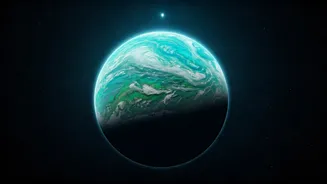
The first possibility was tantalizing: GJ 1214 b could be a water world. This theory suggested the planet formed with a huge amount of water and ice. Given its close, hot orbit around its star, any water would exist as a thick, steamy atmosphere. This dense water vapor would effectively create a blanket that older telescopes couldn't penetrate, hiding the secrets of the world below. The prospect was exciting, as the presence of water, even as vapor, is a key ingredient in the search for potentially habitable environments elsewhere in the universe.
Story 2: A Hazy Methane Planet
The competing theory painted a very different picture. Instead of water vapor, the planet’s atmosphere could be dominated by hydrogen, with a thick haze of hydrocarbon smog, similar to that seen on Saturn's moon, Titan. In this scenario, the atmosphere would be rich in methane. The star's intense radiation would break down the methane, which would then reform into more complex hydrocarbon chains, creating a thick, sooty smog that would perfectly explain the shrouded view. This would make GJ 1214 b less of a water world and more of a small, gassy planet with a dirty secret. With the available data, both stories were equally plausible.
Enter the Webb Telescope
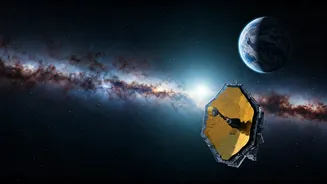
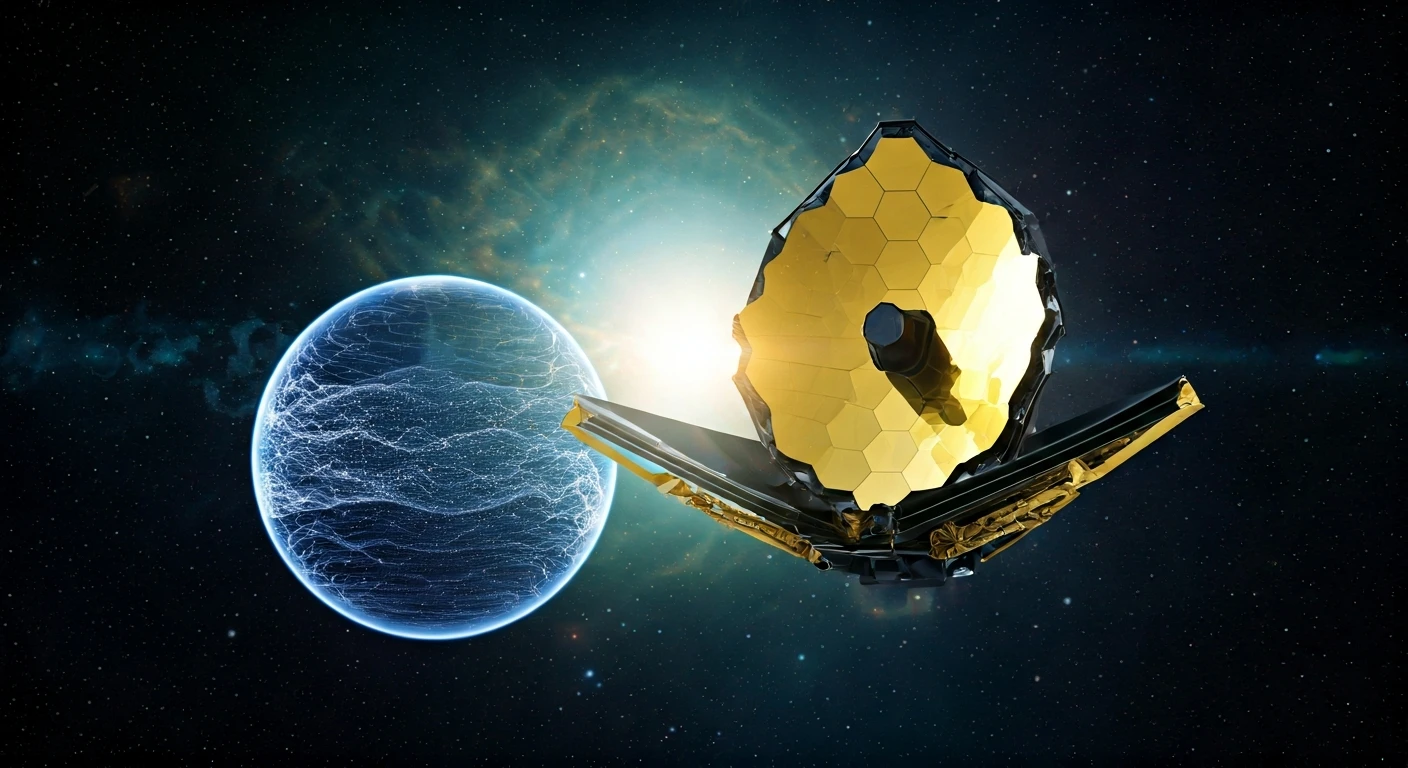
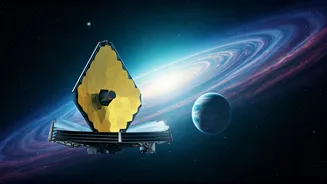
This is where the James Webb Space Telescope (JWST) changed everything. Unlike previous telescopes, Webb is designed to see the universe in infrared light. This ability allows it to peer through the kinds of haze and dust that blind other observatories. A team of astronomers used Webb’s Mid-Infrared Instrument (MIRI) to do something novel: they watched GJ 1214 b for nearly its entire 1.6-day orbit around its star. By capturing the planet’s thermal glow as it moved, they created a heat map and could finally analyze the chemical composition of its mysterious veil.
The Surprising Revelation
So, which story was true? As it turns out, neither was quite right. Webb’s observations revealed a world far more complex and strange. The atmosphere is not dominated by light hydrogen but is rich in heavier molecules like water and methane. Most strikingly, the planet is incredibly reflective. It was much cooler than expected because a significant portion of its star's light was bouncing off a highly reflective, dense haze layer. The data showed clear evidence for water vapor, but also signs that the haze itself could be the product of methane breaking down in the high atmosphere. The planet is a steamy, sooty world—a hybrid that combines elements of both theories but is ultimately unique.