

A Slow But Steady Descent
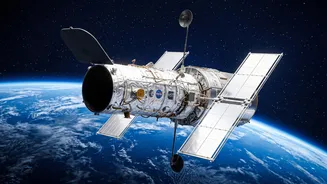
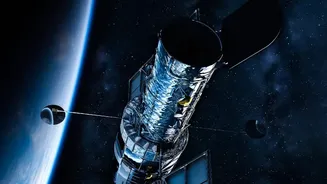
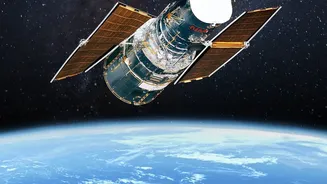
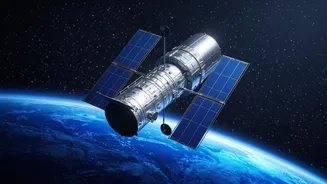
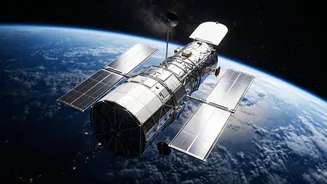
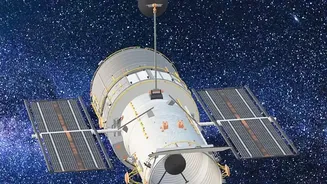
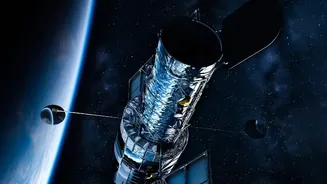
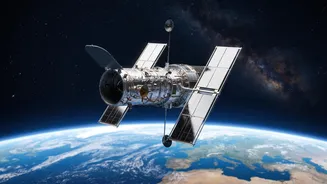
For over three decades, the Hubble Space Telescope has been humanity's tireless eye on the cosmos, revolutionizing our understanding of the universe. But its time is running out. Launched in 1990 to an orbit of about 600 kilometers, Hubble has been slowly
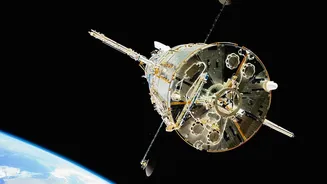
but surely falling back to Earth. The faint atmospheric drag in low-Earth orbit has caused its altitude to decay, and without an onboard propulsion system, it cannot correct its own course. The last time astronauts gave it a boost was during a Space Shuttle servicing mission in 2009. Current projections estimate that if nothing is done, the celebrated observatory could make a final, fiery reentry into the atmosphere sometime between 2033 and 2034. To prevent this, NASA has concluded that any intervention mission would need to happen by 2032.
An Idea Born from a New Space Age
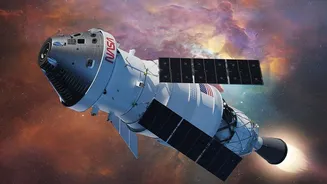
The conversation around a commercially-led rescue mission gained serious traction in 2022. Billionaire entrepreneur Jared Isaacman, who funded the private Inspiration4 and Polaris Dawn spaceflights, proposed a mission using a SpaceX Dragon spacecraft to visit Hubble. The initial idea was to study the feasibility of using the Dragon to rendezvous with the telescope and push it into a higher, more stable orbit, potentially at no cost to the US government. This unsolicited proposal, part of Isaacman’s Polaris Program, represented a significant shift, marrying private ambition with the preservation of a public scientific treasure. While NASA initially studied the concept with SpaceX, the agency ultimately decided not to pursue that specific plan at the time, citing risks and the need for more planning.
From Informal Offer to Formal Request
Now, the idea is officially back on the table. In late October 2026, NASA issued a formal Request for Information (RFI), a significant step that opens the door to the entire commercial space industry. This wasn't just about a reboost; the RFI invited companies to propose concepts for one of three possibilities: boost Hubble to a higher orbit, service it with potential upgrades, or perform a safe, controlled deorbit to dispose of it at the end of its life. This broader request signals NASA's official interest in leveraging the rapidly growing capabilities of the commercial space sector, which has made significant advances in in-orbit servicing and robotics. The agency is now moving to the next phase by asking select companies to conduct more detailed assessment studies based on the information gathered.
What a Commercial Mission Could Look Like
Any company that takes on this challenge would be responsible for providing the launch, the spacecraft, and mission operations. NASA, in turn, would act as the expert consultant, providing the critical technical data on Hubble needed to ensure a safe rendezvous and docking. The primary goal of a reboost mission would be to raise Hubble's orbit to at least 600 kilometers, which could extend its operational life for another two decades or more. The mission could be robotic, using an automated tug to grapple the telescope and push it higher, a concept previously floated by companies like Astroscale and Momentus. Alternatively, it could involve a crewed mission, like the one first proposed by Isaacman and SpaceX, which could open the door to more complex servicing tasks. The challenge is immense, as no spacecraft has visited Hubble since the retirement of the Space Shuttle.