




Your daily life runs on invisible signals from space. But what happens when the Sun unleashes a billion-ton storm of plasma at them? This is the reality of space weather, and a constant, high-tech vigil is the only thing protecting our hyper-connected
world.
The Sun's Violent Outbursts
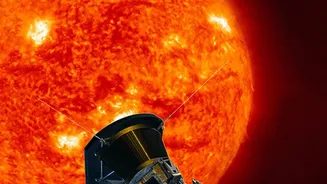
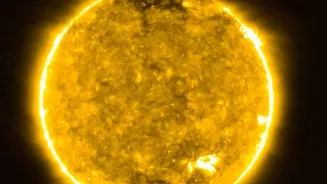
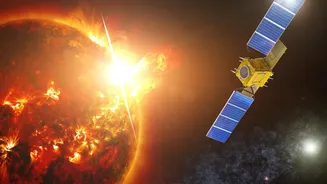
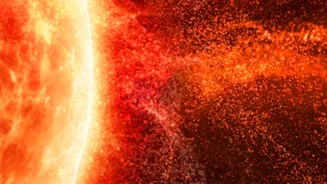
Our Sun, the life-giving star at the center of our solar system, is not always calm. It has a dynamic and sometimes violent nature. The most dramatic of its outbursts are called coronal mass ejections, or CMEs. A CME is a massive eruption of plasma and magnetic fields from the Sun's outer atmosphere, the corona. Think of it as a colossal solar storm, launching billions of tons of material into space at speeds that can exceed hundreds of kilometers per second. These are not the same as solar flares, which are intense bursts of radiation. CMEs are expulsions of actual matter and are the primary drivers of the most significant space weather events that affect Earth.
A Planetary Target
When a CME erupts from the Sun, it travels outward through the solar system. If Earth happens to be in the path of this interplanetary storm, the CME will collide with our planet's magnetic field, the magnetosphere. This protective magnetic bubble usually deflects the constant stream of charged particles from the Sun, known as the solar wind. However, a powerful CME can be overwhelming. The impact can trigger a geomagnetic storm, a major disturbance of the magnetosphere that can have significant effects on technology both in space and on the ground. This journey from the Sun to Earth can take one to four days, giving us a crucial, albeit short, window to prepare.
Satellites in the Crosshairs
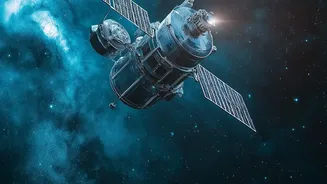
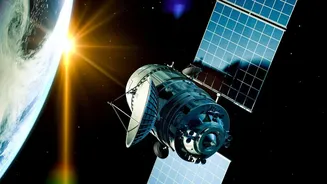
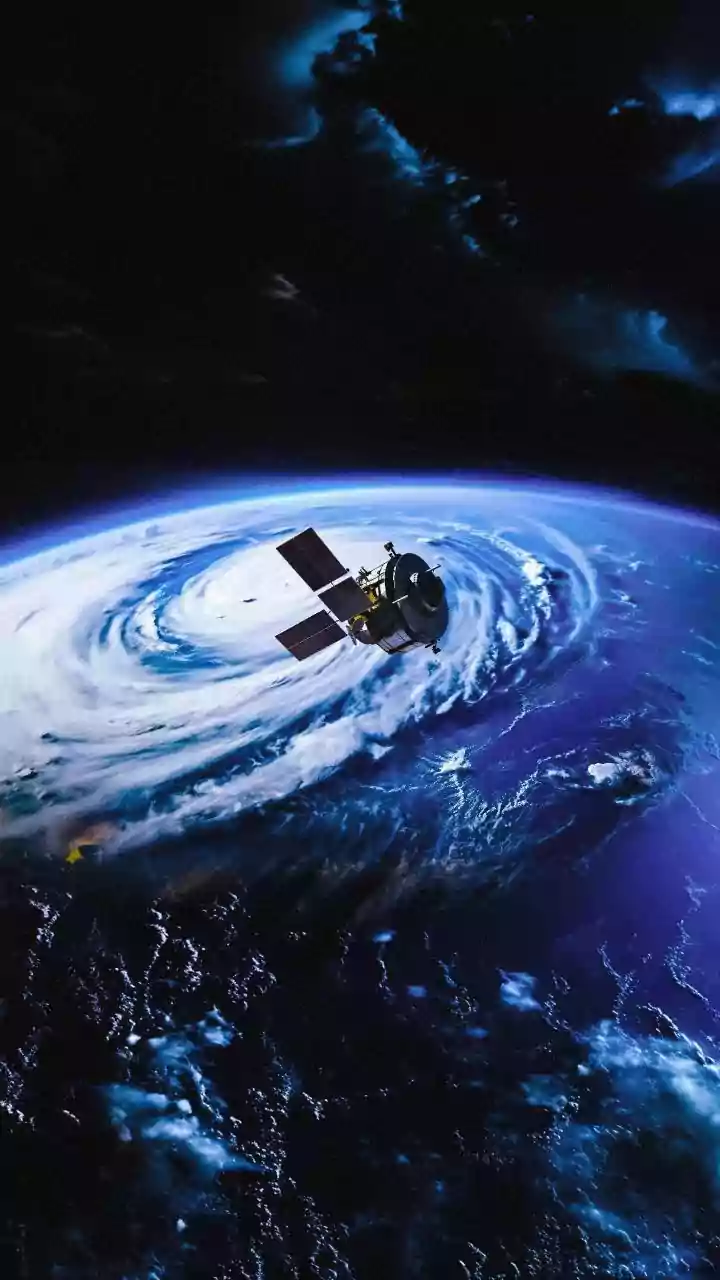
Our modern world is built on a network of satellites orbiting the Earth. They are essential for GPS navigation, global communications, television broadcasting, financial transactions, and weather forecasting. These satellites, operating outside the full protection of Earth's atmosphere, are highly vulnerable to the effects of a geomagnetic storm. The high-energy particles in a CME can damage sensitive electronics, degrade solar panels that power the satellites, and cause system malfunctions. Furthermore, geomagnetic storms can heat and expand Earth's upper atmosphere, increasing drag on satellites in low-Earth orbit and causing them to lose altitude faster than expected. For GPS systems, space weather can distort the signals as they pass through a disturbed ionosphere, reducing accuracy from a meter to tens of meters.
The Global Watch
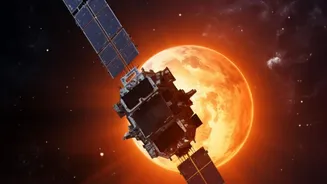
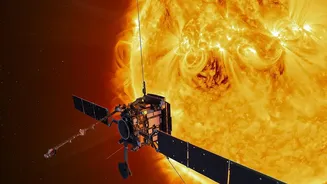
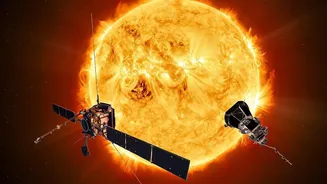
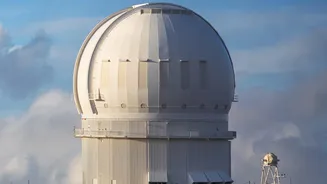
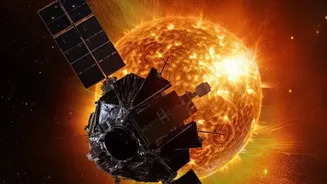
To protect this vital infrastructure, a global network of space weather monitoring stations, both on the ground and in space, keeps a constant eye on the Sun. Spacecraft like NASA's GOES satellites and the Deep Space Climate Observatory (DSCOVR) are positioned to get an early look at what the Sun is doing. A particularly strategic location is Lagrange Point 1 (L1), about 1.5 million kilometers from Earth, where a spacecraft can have an uninterrupted view of the Sun. India has made a significant contribution to this global effort with its Aditya-L1 mission, which is also stationed at L1 to study solar phenomena and provide advance warnings of CMEs.
From Warning to Protective Action
When monitoring stations detect an Earth-directed CME, they issue warnings to satellite operators, airlines, and power grid managers. This advance notice—ranging from hours to days—is critical. With this warning, satellite operators can take protective measures. They might put satellites into a 'safe mode,' temporarily shutting down non-essential and sensitive components to prevent electrical damage. In some cases, they can reorient the satellite to minimize the exposure of critical parts to the incoming particle storm. For very sensitive instruments, physical shielding made of materials like aluminum helps absorb some of the damaging radiation. These actions are a race against time, turning a forecast into a shield that keeps our digital world running smoothly.