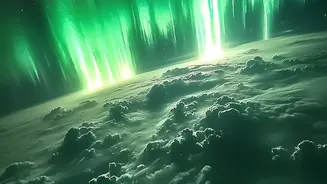





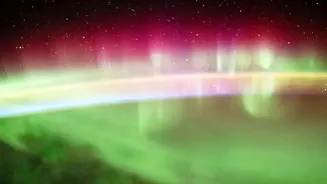

The ethereal dance of the Northern and Southern Lights is one of nature's most breathtaking spectacles. But new research confirms these beautiful auroras are also a visible warning sign of powerful, unseen forces with a direct line to Earth's surface.
More Than a Light Show
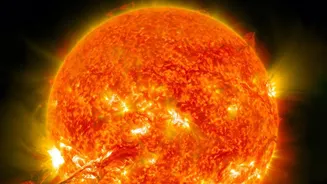
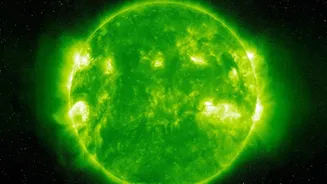
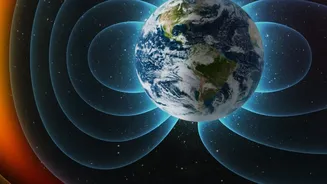
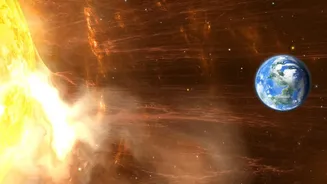
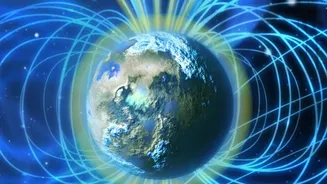
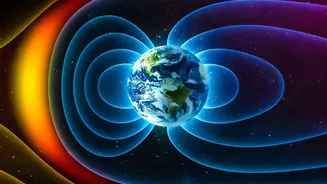
Auroras are the beautiful result of a constant cosmic battle. Earth is shielded by a magnetic bubble called the magnetosphere, which deflects most of the solar wind—a stream of charged particles flowing from the Sun. But sometimes, especially during intense solar events like coronal mass ejections, this shield is overwhelmed. Particles and energy get injected into our upper atmosphere, exciting oxygen and nitrogen atoms to create the famous glowing curtains of light. These events are part of a broader phenomenon called space weather. When they are particularly intense, they trigger what's known as an 'auroral substorm'. This isn't just a gentle glow; it's a dramatic and rapid brightening of the aurora, signifying a massive release of energy in Earth's magnetic tail.
A Jolt on the Ground
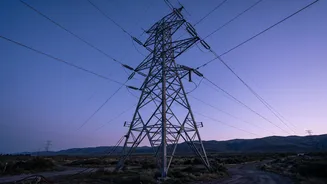
While the aurora dances high in the atmosphere, the same event that causes it can have serious consequences at ground level. The massive release of energy during a substorm generates powerful electrical currents in the ionosphere. These atmospheric currents, in turn, induce electrical currents in the ground beneath our feet. Known as Geomagnetically Induced Currents (GICs), these are not your typical household currents. They are quasi-DC currents that can flow into long conductors like power grids, pipelines, and railway lines. For our electrical infrastructure, which is designed for alternating current (AC), this is bad news. GICs can cause high-voltage transformers to overheat and saturate, potentially leading to voltage instability, equipment damage, and even widespread blackouts.
Forging the Connection
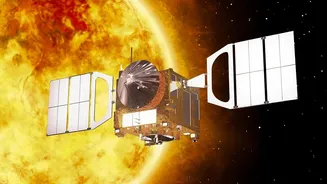
For a long time, scientists understood that auroras and GICs were driven by the same solar activity. The aurora was seen as a visual clue that disruptive currents might be happening on the ground. However, new research has now established a much more direct and rapid link. By combining data from spacecraft with ground-based magnetometers, which measure changes in the magnetic field, scientists have watched the process unfold in near real-time. They observed a burst of energy in the magnetotail, tens of thousands of kilometres away. Within minutes, the aurora brightened dramatically, and almost simultaneously, instruments on the ground detected sharp changes in the magnetic field—the very changes that drive dangerous GICs. The findings show that the effects of a substorm can reach Earth's surface in as little as seven minutes.
Why This Matters for India
While the most intense auroras are seen at high latitudes, major geomagnetic storms can expand the auroral region to affect lower latitudes, and their effects on technology are global. For a rapidly digitising nation like India, the stakes are high. Our increasing reliance on a stable power grid, extensive railway networks, and satellite-dependent systems like GPS makes us vulnerable. A severe space weather event could disrupt navigation systems used in agriculture and transport, create instability in the power grid, and even accelerate corrosion in pipelines. Understanding this immediate link between an auroral brightening and ground-level hazards is a critical step toward better space weather forecasting. It moves us from a general warning of a solar storm to predicting its specific, localised impacts on a timescale of minutes, not hours.