


The Goldilocks Zone Revisited
The traditional concept of a habitable world has long centered on the "Goldilocks Zone." This is the orbital region around a star where the temperature is just right—not too hot, not too cold—for liquid water to exist on a planet's surface. A planet too close
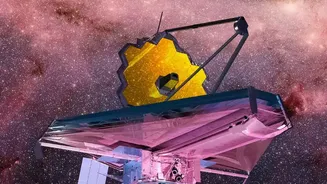
to its star would see its water boil away, while one too far would be a frozen wasteland. This elegant principle has guided astronomers in identifying countless exoplanet candidates that might harbour life. However, this is proving to be an oversimplification. A planet needs more than just the right temperature; it needs a stable atmosphere to protect that surface water and regulate its climate. The JWST is now showing, in unprecedented detail, that a planet's ability to hold onto its atmosphere is a critical, and often fleeting, factor.
The Danger of a Naked Planet
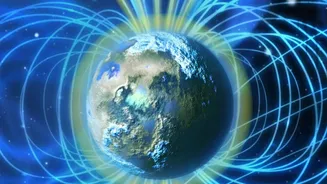
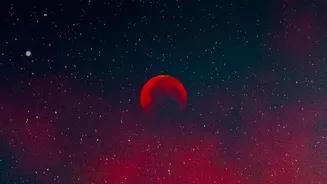
A planetary atmosphere is a fragile shield. It provides air pressure necessary for liquid water, protects the surface from harmful radiation, and distributes heat around the planet to prevent extreme temperature swings. But this protective blanket is under constant assault from its own star. Stars, particularly the common but volatile M-dwarf stars, unleash powerful stellar winds and intense high-energy radiation. This relentless pressure can physically strip a planet's atmosphere away over millions of years, a process known as atmospheric loss or stripping. Scientists have long theorized this happens, but JWST is providing the first direct evidence of this dramatic process in action, forcing a rethink of which planets can truly be considered habitable. A world might be born in the Goldilocks Zone, but if it can't withstand its star's onslaught, it will end up a barren, airless rock.
Webb's Unprecedented View of Atmospheric Escape
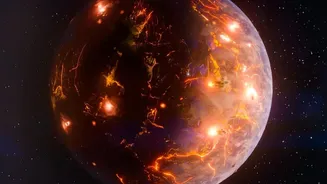
Recent observations have turned theory into stark reality. In one groundbreaking study, JWST observed the exoplanet WASP-107b, a low-density giant known as a 'super-puff'. The telescope didn't just infer atmospheric loss; it watched it happening. Scientists detected a colossal cloud of helium gas escaping the planet so violently that it streamed ahead of the planet in its orbit, stretching for a distance nearly ten times the planet's own radius. In another case, studying the ultra-hot super-Earth TOI-561 b, Webb found evidence of an atmosphere on a world where models predicted one shouldn't be able to survive. This suggests some planets might have ways to replenish their atmospheres, perhaps through volcanic activity bubbling gases up from a molten interior, a process suspected on another hot rocky world, 55 Cancri e. These findings show that atmospheric retention isn't a simple yes-or-no question but a dynamic tug-of-war between planetary and stellar forces.
Redrawing the Map of Habitability
This new data effectively adds a second condition to the Goldilocks principle. A planet doesn't just need to be at the right distance from its star; it also needs to have enough mass (and thus gravity) to hold onto its gases, and its star needs to be stable enough not to blast them away. This is particularly challenging for planets around M-dwarf stars. These stars are the most common in our galaxy, and they were once seen as prime targets in the search for life. However, they are known for their violent flare-ups, especially in their youth. JWST's observations of rocky planets around these stars have often found them to be bare rocks, their atmospheres likely stripped away long ago. The new dividing line for habitability, sometimes called the "cosmic shoreline," separates worlds that have enough gravity and are exposed to low enough radiation to keep their atmospheres from those that do not.
The Search Continues, with Sharper Tools
Rather than being a setback, these discoveries are a crucial step forward. They allow scientists to refine their search, focusing on planets that have a real chance of retaining their atmospheres over geological timescales. This means prioritizing planets around more stable, Sun-like stars or identifying larger, more massive rocky planets that can better withstand the stellar onslaught. It also highlights the importance of understanding a planet's interior geology. A geologically active world with ongoing volcanism might be able to sustain an atmosphere even in a harsh environment, while a geologically dead one cannot. The JWST's ability to analyze the chemical makeup of the few atmospheres it does find—detecting water, carbon dioxide, and other compounds—is providing the data needed to build these more sophisticated models of habitability.