


The Sun’s Unseen Threat
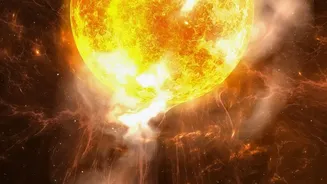
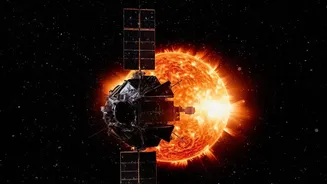
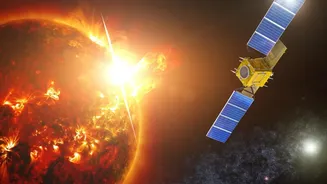
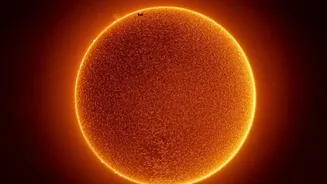
The sun, our life-giving star, has a volatile side. It periodically releases gigantic clouds of plasma and magnetic fields into space in an event called a Coronal Mass Ejection (CME). Think of it as the sun violently sneezing a billion tonnes of material,
sending it hurtling through the solar system at speeds up to 3,000 kilometres per second. These are not just random bursts; they originate from the sun's magnetic field lines becoming twisted and stressed, eventually snapping and reconfiguring in a process called magnetic reconnection. While some CMEs drift harmlessly into deep space, those aimed at Earth pose a significant risk, not to us on the ground, but to the technology we depend on in orbit.
Satellites in the Firing Line
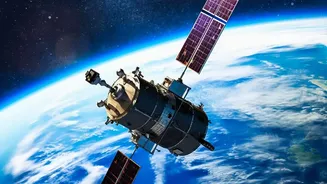
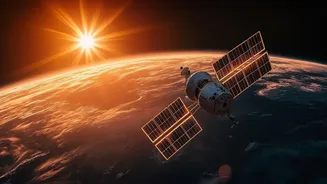
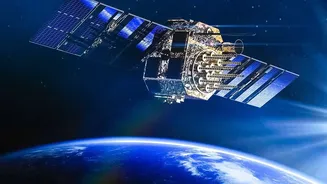
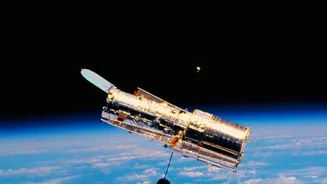
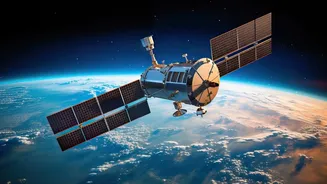
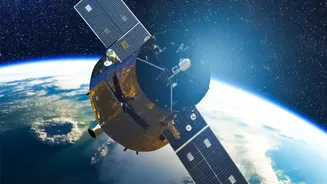
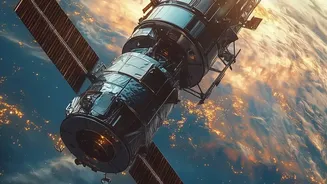
For an orbiting satellite, a direct hit from a CME is a catastrophic event. The primary danger comes from charged particles that can penetrate the satellite, causing a host of problems. This onslaught of space radiation can lead to 'single-event effects,' where a single high-energy particle can flip a memory bit, corrupt data, or even cause permanent damage to sensitive microelectronics. The event can also cause surface charging, where voltage builds up and discharges as a spark, potentially frying circuits. In more severe cases, geomagnetic storms triggered by CMEs can increase atmospheric drag, causing satellites in low-Earth orbit to lose altitude and shorten their operational lifespan, as witnessed with the loss of dozens of Starlink satellites in 2022.
The Power of Prediction
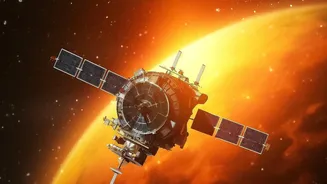
This is where Coronal Mass Ejection modeling comes in. Much like a weather forecast for Earth, space weather prediction aims to give us an early warning of incoming solar storms. By observing the sun, scientists can detect the signs of a CME and model its trajectory, speed, and intensity. Observatories like the NASA/ESA Solar and Heliospheric Observatory (SOHO) use instruments called coronagraphs, which block the sun's bright face to see the fainter corona and spot CMEs as they erupt. More advanced sentinels, like the DSCOVR satellite and India's Aditya-L1, are positioned 1.5 million kilometres from Earth, giving them a direct view of the sun and allowing them to measure the solar wind in real-time. This provides a crucial warning—anywhere from 15 minutes to over an hour—before a storm reaches our planet.
From Forecast to Action
An accurate forecast is useless without a plan of action. When satellite operators receive a warning of an impending CME, they can take several protective measures. The most common action is to switch the satellite into a 'safe mode'. This involves shutting down non-essential and sensitive systems, reorienting the spacecraft to present a smaller cross-section to the incoming particle storm, and ensuring critical systems are protected. For satellites in low-Earth orbit at risk of increased drag, operators might perform a drag make-up manoeuvre, using precious fuel to boost the satellite back to its proper orbit. These actions are a race against time, turning a forecast into a direct risk-reduction strategy that can save a mission worth hundreds of millions of dollars.
The Future of Space Weather Forecasting
As our reliance on satellites for everything from GPS navigation and banking to telecommunications and national security grows, the need for faster and more accurate space weather forecasts has never been greater. The future of CME modeling lies in the fusion of physics-based simulations with artificial intelligence and machine learning. Missions like India's Aditya-L1 are at the forefront, not just observing the sun but providing a constant stream of data to be fed into these new predictive models. Machine learning algorithms can analyze vast datasets from multiple instruments to recognise patterns that precede a CME, improving prediction accuracy and extending the warning lead time from hours to potentially days. This ongoing innovation is essential for safeguarding the ever-growing and increasingly vital infrastructure we have placed in orbit around our planet.