


Timing the Celestial Spectacle
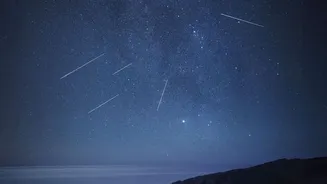
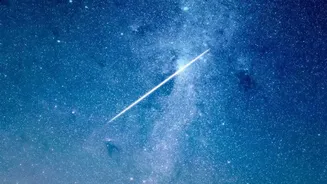
The key to any great meteor shower photo is timing. This year offers a spectacular opportunity with the Perseid meteor shower, which is set to peak on the night of August 12-13, 2026. What makes 2026 truly special is that the peak coincides perfectly
with a New Moon. This means the sky will be exceptionally dark, free from moonlight, allowing even the faintest meteors to be seen and photographed. For observers in India, the best viewing window will be in the pre-dawn hours of August 13, roughly between 2:00 AM and 4:30 AM IST, when the shower's radiant point is high in the sky. During this peak, you could witness up to 100 meteors per hour under ideal conditions.
Escape the City Glow
To capture brilliant stars, you must escape the glow of city lights. Light pollution is a photographer's biggest challenge, washing out the night sky and hiding all but the brightest celestial objects. Finding a dark-sky location is crucial. Fortunately, India has several regions known for their pristine skies. High-altitude deserts like Ladakh and Spiti Valley are considered world-class destinations for astrophotography, with Hanle in Ladakh being home to India's first official Dark Sky Reserve. Other excellent options include the Rann of Kutch in Gujarat, parts of the Western Ghats like Coorg, and desert locations near Jaisalmer in Rajasthan. The main challenge for many during the August peak is the monsoon, which can bring cloud cover. High-altitude or rain-shadow regions are often your safest bet for clear skies.
Essential Gear for the Night
While you don't need professional-grade equipment, a few key items are non-negotiable for capturing shooting stars. At a minimum, you will need a DSLR or mirrorless camera with manual mode, a wide-angle lens, and a sturdy tripod. A wide-angle lens (e.g., 14mm to 24mm) allows you to capture a large expanse of the sky, increasing your chances of a meteor streaking through your frame. The tripod is essential for keeping your camera perfectly still during long exposures. A remote shutter release or using your camera's built-in timer is also highly recommended to avoid camera shake when you press the shutter button. Don't forget to bring a fully charged battery (and a spare!), as long-exposure photography can drain power quickly.
Dialing in Your Camera Settings
Getting your camera settings right is the most technical, but most important, part of the process. Switch your camera and lens to full manual mode. Start with the widest possible aperture (the lowest f-number, like f/2.8 or f/4) to let in as much light as possible. Set your ISO between 1600 and 6400, depending on your camera's capabilities and the darkness of your location. A higher ISO makes the sensor more sensitive to light but can introduce noise or grain. For shutter speed, a good starting point is between 15 and 30 seconds. Finally, and crucially, you must set your focus manually. Autofocus will not work in the dark. Use your camera's live view, zoom in on the brightest star you can find, and manually adjust the focus ring until the star is a sharp, tiny point of light.
Composition and Shooting Strategy
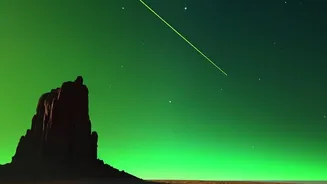
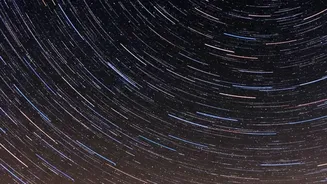
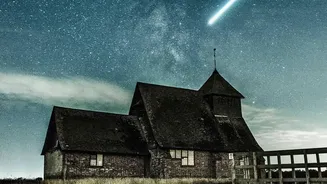
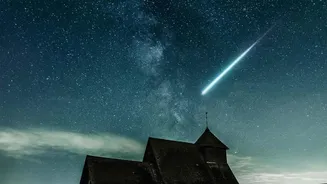
A great photo tells a story. Instead of just pointing your camera at the sky, try to include an interesting foreground element like a distinctive tree, a mountain silhouette, or an old structure. This adds a sense of scale and place to your image. Once you have your composition and settings, the strategy is a game of patience and probability. Set your camera to continuous shooting mode and lock your remote shutter. The camera will then take one photo after another, maximizing your chances of capturing a meteor. The goal is to shoot hundreds of frames over the course of an hour or more. Most will be just stars, but a few will hopefully contain the prized streaks of the Perseids. This continuous shooting method also provides the images needed to create a star trail photograph in post-processing.