
A New Eye on the Sky
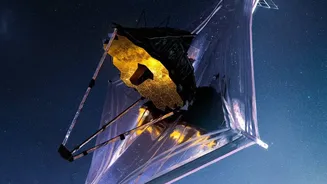
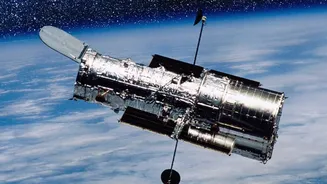
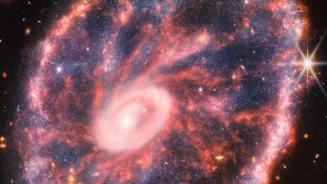
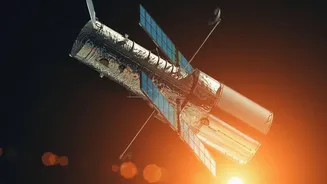
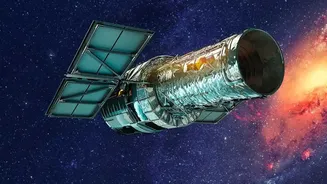
Set to launch by late 2026 or May 2027, the Nancy Grace Roman Space Telescope is NASA's next great observatory, following in the footsteps of giants like the Hubble and James Webb Space Telescopes. Named after NASA's first chief astronomer, Roman is designed
with a specific purpose: to tackle huge cosmic questions about dark energy and, crucially, to conduct a massive census of planets outside our solar system, known as exoplanets. While Hubble and Webb are famed for their deep, narrow views of the universe, Roman is all about the big picture. Its primary mirror is the same size as Hubble's, but its Wide Field Instrument will provide a field of view 100 to 200 times greater. This means it can map the sky with incredible speed, capturing vast panoramic images with the same sharp resolution we've come to expect from Hubble.
The Power of Gravitational Microlensing
Roman’s primary method for finding hidden worlds is a fascinating technique called gravitational microlensing. This method relies on a principle from Einstein's theory of general relativity: gravity bends spacetime. When a star or planet passes almost perfectly in front of a more distant star from our perspective, its gravity acts like a natural magnifying glass. This foreground object temporarily focuses and brightens the light of the background star. Astronomers can detect this brief spike in brightness and analyze it to learn about the lensing object, even if it's too dim to see directly. If the foreground star has a planet, the planet's own gravity creates a second, smaller spike in the light curve. This is Roman's secret weapon. It allows the telescope to detect planets that are much farther away and much smaller than other methods typically can, including worlds similar in mass to Earth.
Finding the Galaxy's Lost Planets
To date, most of the nearly 6,300 confirmed exoplanets have been found using the 'transit' method, which spots the tiny dip in a star's light as a planet passes in front of it. This technique is most effective at finding large planets orbiting very close to their stars. Microlensing, on the other hand, is uniquely suited to find planets on wider orbits, similar to those of Earth, Jupiter, or Saturn in our own solar system. Roman is expected to find thousands of new exoplanets this way. Perhaps most excitingly, microlensing is the best way to find 'rogue planets'—worlds that drift through the galaxy untethered to any star. These lonely wanderers are essentially invisible, but their gravitational influence can still be detected. Scientists estimate Roman could find hundreds of these rogue worlds, potentially revealing that there are trillions of them wandering our galaxy alone.
A Galactic Census Like No Other
The sheer number of planets Roman is expected to find—some estimates suggest around 100,000 through a combination of methods—will be transformative. This vast dataset will provide a statistical treasure trove for astronomers, allowing them to understand how common different types of planets are, from gas giants to rocky worlds. The mission will survey the crowded central bulge of our Milky Way, an area that has been largely unexplored in the hunt for exoplanets. This will help scientists understand if planetary systems in different parts of the galaxy form and evolve differently from those in our own stellar neighbourhood. While Roman will do the broad survey work, it will also work in tandem with the James Webb Space Telescope. Roman can identify interesting targets across its wide field of view, and Webb can then perform detailed follow-up observations to study their atmospheres.