



Meet the Solar System's Slowpoke
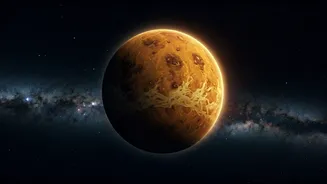
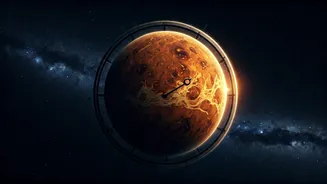
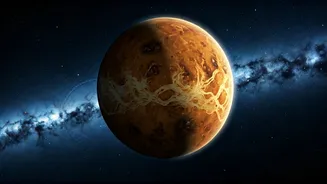
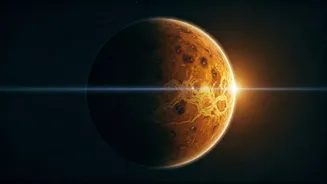
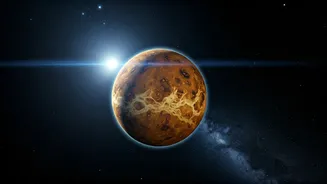
The planet in question is Venus, often called Earth's "sister planet" due to its similar size and mass. But that's where the family resemblance ends. When it comes to rotation, Venus is the ultimate outlier. While Earth completes a spin on its axis in about
24 hours, giving us our familiar day-night cycle, Venus takes a staggering 243 Earth days to do the same. This makes its rotational period the slowest of any planet in our solar system, so slow that it defies easy explanation and challenges our understanding of how planets evolve.
A Day Longer Than a Year
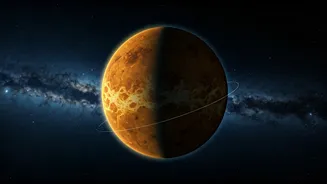
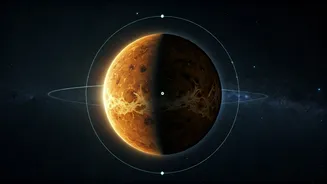
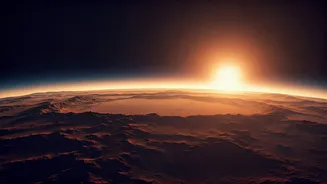
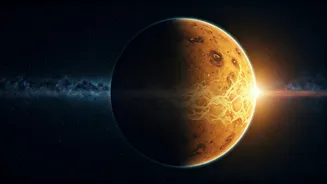
Here's where it gets truly mind-bending. Venus orbits the Sun in about 225 Earth days. If you do the maths, you'll realise its day (one full rotation) is longer than its year (one full orbit). If you could stand on the surface of Venus, you would experience a single sunrise-to-sunrise cycle (a 'solar day') that lasts about 117 Earth days. This is because the planet is rotating very slowly in one direction while orbiting the Sun in another. For any potential future colonists, this would mean enduring nearly two months of daylight followed by two months of darkness. This simple, staggering fact is what keeps the astronomical community buzzing; it's a fundamental property that makes Venus one of the most alien places imaginable.
Spinning the Wrong Way
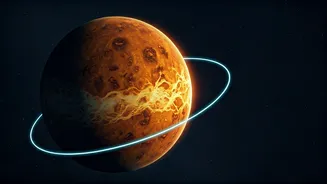
As if being incredibly slow wasn't strange enough, Venus also spins backwards. Nearly every planet in the solar system, including Earth, rotates on its axis from west to east. This is called prograde rotation, and it means the Sun rises in the east and sets in the west. Venus, however, has a retrograde rotation, spinning from east to west. On Venus, the Sun would rise in the west and set in the east. Only Uranus, which is tilted on its side and essentially rolls along its orbit, shares a similarly bizarre rotational behaviour. This backward spin adds another layer of complexity to the puzzle of why Venus is the way it is.
The Mystery of the Missing Speed
So, why is Venus so slow and spinning the wrong way? For a long time, the leading theory involved a cataclysmic event in the distant past. Scientists hypothesised that a massive asteroid or protoplanet slammed into Venus early in its history, sending it into its strange, slow, backward spin. While a giant impact could certainly alter a planet's rotation, a newer and more compelling theory has gained traction, and it points to something Venus is famous for: its atmosphere. Venus is blanketed by a crushing, dense atmosphere, 90 times thicker than Earth's. This super-rotating ocean of air creates powerful atmospheric tides.
Atmosphere as a Planetary Brake
The current leading model suggests that friction between this thick, heavy atmosphere and the planet's solid surface has acted as a powerful brake over billions of years. Think of it like trying to spin a ball underwater versus in the air; the resistance is immense. Solar energy heats the atmosphere, creating thermal tides that pull on the planet's surface, slowing its rotation. This atmospheric drag, exerted over geological timescales, could be strong enough not only to slow the planet down from an initially faster, Earth-like rotation but to eventually reverse it. Recent radar observations from space probes have supported this theory, showing how the atmosphere tugs on Venus's mountains and plains, subtly altering its spin rate. The buzz isn't just about a weird fact; it's about the ongoing discovery of the forces that shape entire worlds.