





The Pacific's Big Disruptor: El Niño
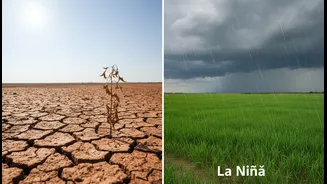
The most famous climate pattern influencing the monsoon is the El Niño-Southern Oscillation (ENSO). When the central and eastern Pacific Ocean becomes warmer than usual—a condition known as El Niño—it sets off a chain reaction in the atmosphere. This
shift can weaken the trade winds and disrupt the typical circulation patterns that drive moisture towards India. Historically, many of India's most severe droughts have coincided with strong El Niño years. Conversely, its counterpart, La Niña, involves a cooling of the same Pacific waters and generally tends to be favourable for the Indian monsoon, often leading to above-average rainfall.
The Indian Ocean's Counter-Move
The Pacific doesn't have the only say. The Indian Ocean has its own powerful climate mode: the Indian Ocean Dipole (IOD). Think of it as a tug-of-war across the ocean. During a 'positive' IOD phase, the western part of the Indian Ocean near Africa becomes warmer than the eastern part near Indonesia. This temperature difference helps push moisture-laden winds towards the Indian subcontinent, strengthening the monsoon. Crucially, a strong positive IOD can act as a saviour, sometimes partially or even largely offsetting the negative impact of an El Niño. In years like 1997 and 2019, a positive IOD helped bolster monsoon rains despite the presence of El Niño conditions. A 'negative' IOD does the opposite, often weakening the monsoon.
The Intraseasonal Pulse: Madden-Julian Oscillation
A lesser-known but significant player is the Madden-Julian Oscillation (MJO). Unlike El Niño or the IOD, which are seasonal patterns, the MJO is a massive, eastward-moving pulse of clouds, rainfall, and wind that travels around the equator every 30 to 60 days. It's not a standing condition but a travelling wave. When the MJO's active phase (characterised by enhanced rainfall and convection) passes over the Indian Ocean, it can give the monsoon a significant boost, potentially triggering its onset or reviving it during a dry spell. Conversely, when its suppressed phase lingers, it can lead to 'breaks' in the monsoon with reduced rainfall. The MJO helps explain the week-to-week variability we often see within a single monsoon season.
A Complex Climate Tug-of-War
These systems don't operate in isolation. They interact in complex ways, sometimes reinforcing each other and sometimes pulling in opposite directions. For instance, a year could see a strong El Niño (bad for the monsoon) and a strong positive IOD (good for the monsoon) at the same time. The ultimate outcome for India's rainfall depends on which pattern is stronger and the timing of their peaks. Add in the shorter-term influence of the MJO, and the task of forecasting the monsoon becomes a monumental challenge for meteorologists. They must analyse a global jigsaw puzzle where pieces are constantly moving and influencing each other.
The Shadow of a Warming World
Overlaying all these natural patterns is the undeniable influence of climate change. The Indian Ocean is warming faster than the global average. While this can mean more moisture is available in the atmosphere, it is also changing the character of the monsoon. Experts note that climate change is making rainfall more erratic, leading to long dry spells punctuated by bursts of extremely heavy, intense rain. This new reality, where climate change interacts with and amplifies natural patterns like El Niño, further complicates the monsoon's behaviour, making it less predictable and its impacts more severe.