
A Glimpse into the Cosmic Dawn
Imagine trying to see a candle flicker from thousands of kilometers away, but with a thick fog bank in between. That’s the challenge astronomers faced when trying to study the universe's earliest moments. For hundreds of millions of years after the Big
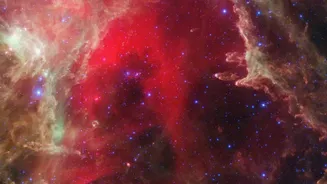
Bang, the cosmos was filled with a dense, opaque fog of neutral gas. This era, known as the Cosmic Dark Ages, ended when the first stars and galaxies ignited, a period called the Cosmic Dawn. Their intense ultraviolet light gradually cleared the fog in a process called reionization, making the universe transparent. However, the very nurseries where these first stars were born have remained shrouded in mystery and cosmic dust, invisible to most telescopes.
Webb’s Unprecedented Infrared Vision
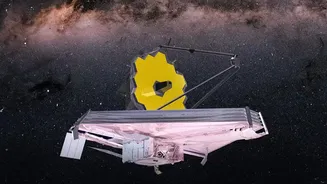
This is where the James Webb Space Telescope changes everything. Unlike the Hubble Space Telescope, which primarily sees in visible and ultraviolet light, JWST is designed to see the universe in infrared. This is crucial for two reasons. First, the light from the most distant galaxies has been stretched by the expansion of the universe into longer, redder wavelengths—a phenomenon called redshift. Light that was once visible or ultraviolet is now infrared. Second, and perhaps more importantly for finding star nurseries, infrared light can penetrate the thick clouds of cosmic dust that absorb visible light. It gives JWST the equivalent of cosmic night-vision goggles, allowing it to see what was previously hidden.
Discovering the Hidden Nurseries
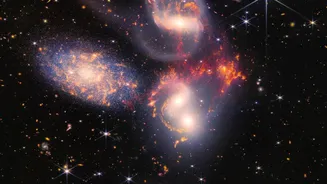
Armed with this capability, astronomers have pointed JWST at 'deep fields'—small patches of the sky observed for extended periods to capture the faintest, most distant light. In these deep-field observations, such as those from the JWST Advanced Deep Extragalactic Survey (JADES), scientists have uncovered hundreds of galaxies that existed when the universe was less than 600 million years old. Within these ancient galaxies, Webb has revealed what the headline calls 'secret star nurseries.' These are not just individual stars, but brilliant clumps and pockets of intense star formation that were previously just smudges in Hubble's view, or completely invisible. These regions are crackling with the formation of young, hot, massive stars.
More Stars Than We Ever Imagined
The revelations go beyond just locating these nurseries. Recent studies using JWST data suggest that these early galaxies contain a surprisingly large population of faint, low-mass stars, in addition to the bright, massive ones. Previous estimates of galactic mass were based only on the brightest, most visible stars, like judging a city's population by looking only at its tallest skyscrapers. By detecting these fainter stars, astronomers now believe these early galaxies could be up to four times more massive than previously thought. This implies that star formation in the early universe was far more efficient and widespread than our models had predicted, and that the cosmos was buzzing with activity much sooner than we knew.
Rewriting the First Chapter of the Universe
These discoveries are fundamentally changing our understanding of how the first galaxies grew and evolved. Finding that these early galaxies were so adept at creating stars helps explain how the universe became reionized so quickly. The sheer number of hot, massive stars found by Webb would have produced immense amounts of ultraviolet light needed to burn off the cosmic fog. Furthermore, by being able to see these individual 'pods' of star formation, scientists can refine their models of galaxy assembly. We are no longer looking at fuzzy blobs but at structured objects with distinct regions of star birth, providing a detailed blueprint of the universe's first construction sites.