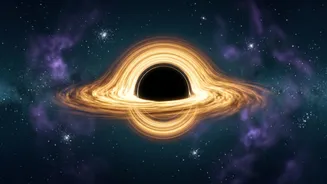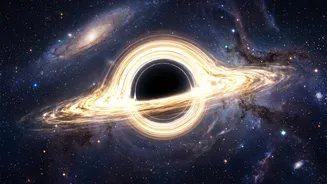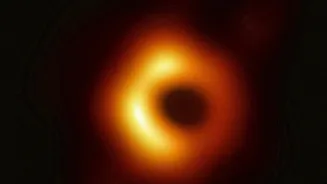



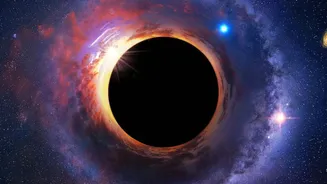
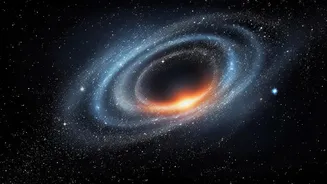
Astronomers believe our Milky Way galaxy contains over 100 million black holes, yet we have only found a tiny fraction of them. Now, a groundbreaking project is enlisting an unexpected ally in the search: you.
Democratising the Cosmos
The hunt for black holes, the universe's most
mysterious objects, is no longer confined to scientists in high-tech observatories. Through projects like Black Hole Hunters, anyone with a computer and an internet connection can join the search. This collaborative effort between professional researchers and the public is part of a growing movement called citizen science. It leverages the power of crowdsourcing to tackle enormous datasets that would be impossible for small teams of scientists to analyse on their own. The Zooniverse platform, a hub for people-powered research, hosts Black Hole Hunters, inviting volunteers to make a real impact on our understanding of the cosmos.
How to Hunt for an Invisible Giant
So, how does one find an object that, by definition, emits no light? The Black Hole Hunters project looks for a clever cosmic trick called gravitational microlensing. Many massive stars exist in pairs, orbiting a common centre of gravity. When one of these stars collapses into a black hole, it can remain in orbit with its stellar companion. If this pair aligns perfectly with Earth, the black hole's immense gravity will periodically pass in front of the star, bending and magnifying its light like a lens. This causes a distinct, symmetrical peak in the star's brightness for a short period. It is this unique signature that volunteers are trained to spot.
The Power of the Human Eye
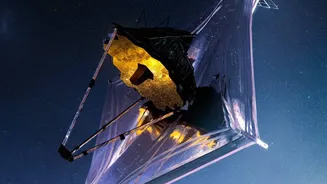
The project uses vast amounts of data collected by telescopes like NASA's Transiting Exoplanet Survey Satellite (TESS) and the earlier SuperWASP survey. While these telescopes are masters at recording tiny changes in starlight, automated computer algorithms struggle to differentiate the rare, one-off peak of a microlensing event from other stellar variations and data noise. This is where human pattern recognition excels. Volunteers are shown graphs of a star's brightness over time—known as light curves—and asked to identify any that show the tell-tale symmetrical peak. No advanced degree is required; the task is fundamentally about recognising a visual pattern. By flagging promising candidates, volunteers create a shortlist for professional astronomers to investigate further with other telescopes.
A New Frontier in Discovery
The project, a collaboration between institutions like the University of Southampton and The Open University, has been a resounding success. Since its launch, tens of thousands of volunteers have made millions of classifications, sifting through data on hundreds of thousands of stars. While finding a confirmed black hole through this 'self-lensing' method would be a first, the project is generating a massive, clean dataset that is invaluable for astronomy. The classifications provided by volunteers are now being used to train machine-learning models, creating a powerful synergy where humans teach computers how to search even more efficiently in the future. This demonstrates a new, hybrid model for scientific discovery, blending human intuition with artificial intelligence.
The Bigger Picture for Science
The Black Hole Hunters project is more than just an innovative way to search for elusive cosmic objects. It represents a fundamental shift in how science can be conducted. Citizen science initiatives are proving indispensable across various fields, from identifying new galaxies and tracking wildlife populations to finding lost NASA satellites. They not only accelerate the pace of research but also foster a deeper connection between the public and the scientific process. By giving people a direct role in discovery, these projects demystify complex topics and inspire a new generation of enthusiasts and potential scientists. It proves that some of the biggest questions in the universe can be tackled not just by a handful of experts, but by a global community driven by curiosity.