



A Cosmic Fireworks Display
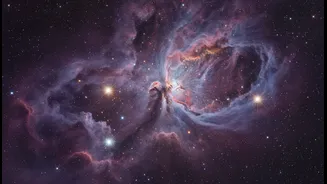
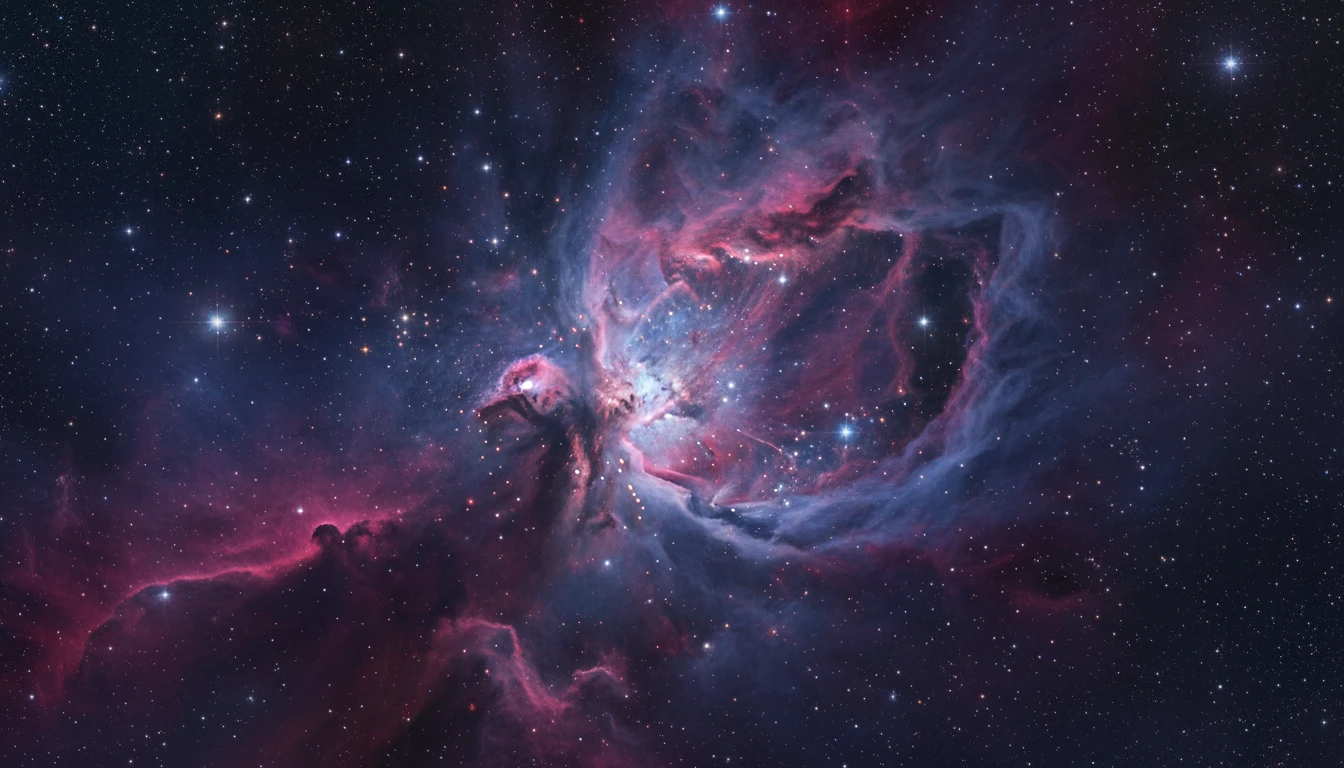
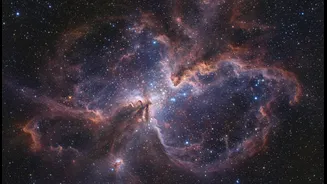
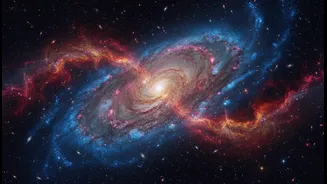
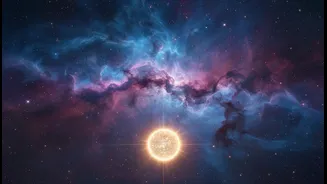
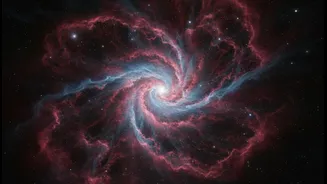
A spectacular new image from NASA’s Hubble Space Telescope showcases LH 95, a vast region where thousands of new stars are coming to life. Located in the Large Magellanic Cloud, a small galaxy that orbits our own Milky Way, LH 95 is a chaotic and beautiful
environment. The image resembles a cosmic fireworks display, with brilliant blue and white stars sparkling against glowing crimson clouds of hydrogen gas. These aren't just pretty colours; they are a direct visualization of the science at play. The red glow comes from hydrogen gas being heated by the intense radiation from the most massive newborn stars, while dark filaments of dense dust stand out in sharp contrast, resisting the energetic onslaught. This single snapshot provides an unusually clear window into a process that is fundamental to the structure of the universe, and our own existence within it.
The Recipe for a Star
So, how does a star begin its life? The process starts within immense, cold clouds of gas and dust that drift through interstellar space. Gravity, the universe’s great architect, slowly pulls the densest clumps of this material together. As a clump collapses, it begins to spin and heat up, forming a hot, dense core known as a protostar. For millions of years, this stellar embryo continues to pull in more gas and dust from a surrounding disk, growing in mass and temperature. The recent Hubble observations of LH 95 have given scientists a clearer look at this crucial phase, revealing about 2,500 young stars that have gathered most of their mass but have not yet ignited nuclear fusion in their cores. Once the core becomes hot and dense enough, a monumental event occurs: nuclear fusion begins, converting hydrogen into helium. This process releases an enormous amount of energy, which pushes outward and balances gravity’s inward pull, marking the birth of a stable, shining star.
What Makes This View Special
While Hubble has studied many stellar nurseries, LH 95 is a particularly valuable natural laboratory. Because it lies in a neighbouring galaxy, it has a different chemical composition and lower levels of obscuring dust compared to similar regions in our Milky Way. This gives astronomers an unusually unobstructed view of stars at many different stages of development, all in one place. The new observations confirm that star formation in LH 95 isn't happening all at once but in successive waves. The powerful winds and radiation from the first generation of massive stars can both blow away the raw material for star-making and, in other areas, compress gas to trigger the birth of a new generation. This process of stellar feedback is crucial for understanding how galaxies evolve over billions of years.
Hubble's Enduring Legacy
For over three decades, the Hubble Space Telescope has transformed our understanding of the cosmos, and this new image is a testament to its enduring power. It works in concert with newer observatories like the James Webb Space Telescope, which can peer even deeper into dust-shrouded regions with its infrared vision. Hubble's strength in visible and ultraviolet light provides a crucial and complementary view. The colours in this image, for instance, tell a story: blue represents hotter, more massive young stars, while the red glow of hydrogen gas is a key indicator of active star formation. By studying regions like LH 95, astronomers can piece together the timeline of how stars of all sizes form, live, and die, ultimately enriching the universe with the heavier elements necessary for planets and, eventually, life. Every new image is a new page in the story of our cosmic origins.