



The Cosmic Quest for Life's Bricks
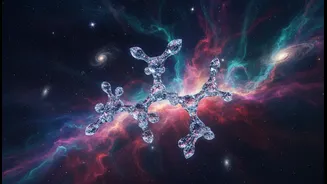
At the heart of every living thing on Earth are proteins, complex machines that perform countless jobs inside our cells. These proteins are built from smaller units called amino acids. Because of this, amino acids are often called the "building blocks
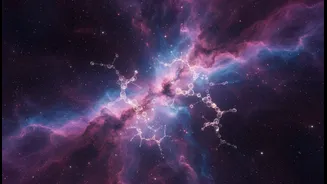
of life." Understanding where they came from is crucial to understanding our own origins. For decades, scientists have wondered if these vital molecules first formed on a young Earth, or if they were delivered here by comets and asteroids. Recent research increasingly points to an even earlier origin: the vast, cold clouds of gas and dust that exist between stars. These interstellar clouds are the raw material from which new stars and planets are born. If amino acids can form there, it means the ingredients for life could be widespread throughout the universe.
A Universe in a Bottle
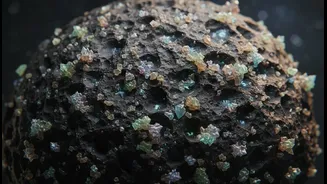
To test this hypothesis, scientists create a 'universe in a bottle' inside their labs. The "glass tube" from the headline is actually a sophisticated ultra-high vacuum chamber. Inside this chamber, researchers replicate the harsh conditions of an interstellar cloud. First, they introduce a mixture of simple gases like water, carbon monoxide, methanol, and ammonia—molecules that telescopes have detected in abundance in deep space. This mixture is then cooled to incredibly low temperatures, around minus 260 degrees Celsius, causing the gases to freeze into a thin layer of ice on a simulated dust grain. This setup creates a tiny, controlled slice of a cosmic cloud, ready for the next crucial step: a star.
Simulating a Young Sun's Fury
A newborn star blasts its surroundings with intense radiation. To mimic this energetic process, researchers use various tools to irradiate their lab-made ice. Some experiments use powerful ultraviolet (UV) lamps, while others employ particle accelerators to bombard the ice with high-energy protons, simulating the cosmic rays that zip through interstellar space. This jolt of energy is the catalyst. It breaks apart the simple, frozen molecules, shattering their chemical bonds and creating highly reactive fragments. These fragments then have the opportunity to recombine in new and more complex ways, kickstarting a chain of chemical evolution.
From Simple Ice to Complex Organics
After the irradiation phase, the sample is slowly warmed up. As the temperature rises, the newly formed molecules are released from the ice and can be analyzed. Scientists use highly sensitive instruments like mass spectrometers to identify the chemical composition of the resulting 'gooey residue'. In numerous experiments, the results have been astounding. These simulations have successfully produced not only simple amino acids like glycine but also their chemical precursors. Some studies have even identified nucleobases—the building blocks of DNA—and dipeptides, which are two amino acids linked together, representing a step towards creating proteins. These findings demonstrate that the journey from simple inorganic molecules to the complex organic compounds necessary for life is a plausible one, even in the cold, dark emptiness of space.
The Dawn of Life Could Be Universal
The success of these laboratory simulations has profound implications. It suggests that the formation of life's essential ingredients is not a rare fluke but a natural consequence of astrophysics. The process doesn't necessarily require the 'warm little pond' once imagined on early Earth; it can begin long before planets even form, within the very clouds that give them birth. This concept, known as prebiotic chemistry, pushes the timeline for life's origins further back and expands its potential reach. If the building blocks of life are common in interstellar clouds, it's conceivable that they were incorporated into countless comets, asteroids, and planets across our galaxy and beyond, including early Earth. This greatly increases the odds that life, in some form, might not be unique to our planet.