



A Telescope Unlike Any Other
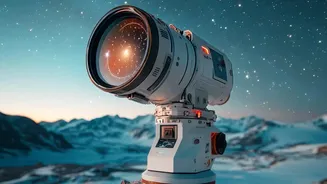
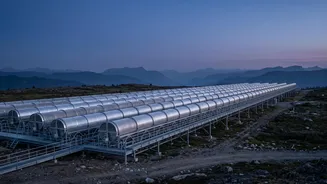
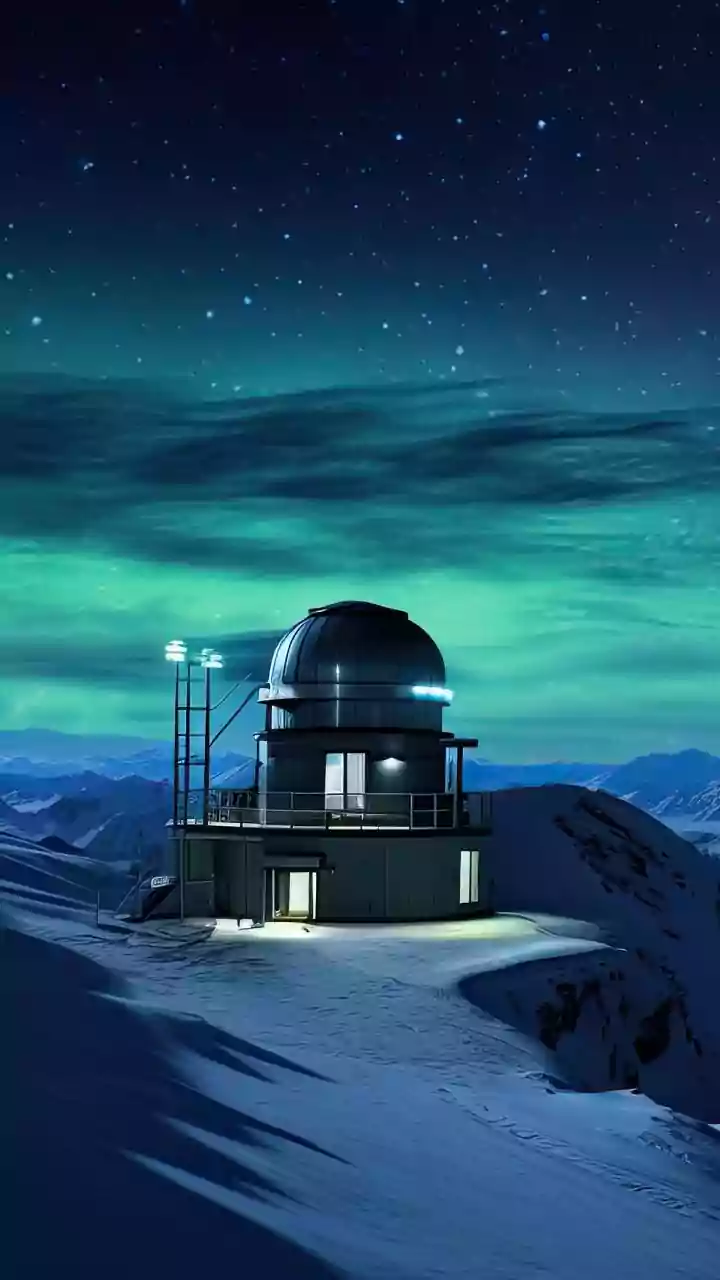
Deep in the hills of British Columbia, Canada, sits a telescope that looks more like a set of giant snowboarding half-pipes than a traditional space observatory. This is the Canadian Hydrogen Intensity Mapping Experiment, or CHIME. Unlike conventional
telescopes that use large, steerable dishes to focus on one patch of sky at a time, CHIME is stationary. It consists of four large cylindrical reflectors with no moving parts, which drastically reduces its construction and operational costs compared to other world-class radio telescopes. Instead of physically moving, it relies on the Earth's rotation to scan the sky, using immense computing power to process signals from over a thousand antennas. This design allows it to monitor a huge portion of the sky simultaneously, making it exceptionally good at catching fleeting cosmic events.
The New Cosmic Toolkit
Traditionally, studying cosmic expansion has been an expensive endeavour. It often involves meticulously mapping the positions of individual galaxies using powerful optical telescopes, a slow and costly process. CHIME introduces two more efficient methods. The first is its primary mission: 'intensity mapping'. Instead of counting individual galaxies, it measures the faint, collective radio glow of vast clouds of hydrogen gas from the distant universe. This hydrogen acts as a tracer, revealing how matter is distributed across space and allowing scientists to measure the universe's expansion history at a fraction of the cost. More recently, CHIME has proven its ability to do this using only its own data, a major breakthrough that makes the process faster and more self-reliant.
Hitching a Ride on Fast Radio Bursts
CHIME's second, and perhaps even more ingenious, method involves using mysterious signals from deep space known as Fast Radio Bursts (FRBs). These are incredibly bright, millisecond-long flashes of radio waves from unknown but extremely powerful sources. CHIME's wide field of view has made it a world-leading FRB detector, spotting thousands of these events. Scientists can use these bursts as cosmic probes. As an FRB travels across billions of light-years, its signal gets slightly stretched and smeared out by the gas and matter it passes through. By analyzing this distortion, researchers can measure the distribution of matter in the universe and, by extension, calculate the rate of cosmic expansion at different points in history. This provides an entirely new and independent yardstick for measuring our universe.
Why Cheaper is a Game Changer
The 'cheaper approach' isn't just about saving money; it's about accelerating the pace of discovery. The telescope was built for a fraction of the cost of comparable instruments by using commercially available technology, like components developed for the mobile phone industry and gaming computer graphics cards. This affordability democratizes the study of cosmology. By proving these lower-cost techniques work, CHIME paves the way for more instruments to be built and more data to be collected. This allows scientists to test competing theories about dark energy more rapidly and independently. The ability to map vast volumes of the universe without the painstaking process of cataloging individual galaxies means that answers to some of the biggest questions in physics could arrive sooner than we thought.