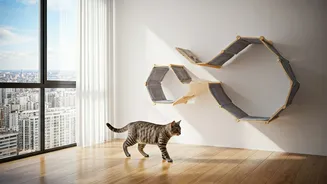









Why Cats Crave Height
Before you start drilling, it’s important to understand why cats are so drawn to high places. In the wild, their ancestors sought elevation for two key reasons: safety and hunting. From a high perch, a cat can survey its territory for potential threats
and spot prey from a safe distance. For our indoor companions, this instinct remains powerful. A vertical space, or 'cat superhighway', provides them with a secure area where they feel in control, away from household foot traffic, other pets, or boisterous children. It enriches their environment, prevents boredom-related behaviours, and effectively increases their usable living space, which is a game-changer in smaller urban homes.
Planning Your Cat's Superhighway
Good design starts with a plan. Don’t just place a random shelf on the wall. Observe your cat's current habits. Where do they like to nap? Which windows do they look out of most? Your goal is to create a functional route that connects these points of interest. Sketch out a path on paper. Think about flow. The highway should have multiple entry and exit points so your cat never feels cornered. A simple route could start with a low shelf or cat tree near the sofa, ascend via a series of staggered shelves, cross a 'bridge' over a doorway, and end at a comfortable perch with a view of the outside world. Ensure there is enough space between shelves for a comfortable jump—typically 30-45 cm vertically and horizontally, but adjust for your cat's age and agility.
Choosing Safe and Sturdy Materials
Your cat's safety is the top priority. All materials must be non-toxic and incredibly sturdy. For shelves, solid wood like pine is an excellent, durable choice. Avoid particleboard or MDF, which can sag or break under a cat's weight, especially during energetic leaps. For the all-important bridges, you can use a solid plank of wood or create a suspended bridge using thick, natural rope (like sisal or manila) and a sturdy wooden base. For grip, cover shelves with a low-pile carpet remnant, cork, or wrap them tightly with sisal rope. This provides necessary traction for jumping and a satisfying surface for scratching. Ensure any paints or sealants you use are certified pet-safe and fully cured before installation.
Installation: The Most Critical Step
Even the best materials are useless without proper installation. Your wall setup must be able to withstand a cat landing on it with force. The golden rule is to anchor shelves and brackets directly into wall studs wherever possible. A stud finder is an inexpensive and essential tool for this. For plaster or brick walls, you will need the appropriate heavy-duty wall anchors or plugs designed to hold significant weight. Don't rely on simple drywall anchors meant for hanging pictures. Always use high-quality, strong metal brackets. After installing each component, perform a firm weight test by pulling down on it with considerable force. If it moves, wiggles, or feels even slightly insecure, take it down and re-install it correctly. It's better to be overly cautious.
Encouraging Your Cat to Explore
Some cats will take to their new highway immediately, while others may be more hesitant. Don't force them. Instead, entice them to explore on their own terms. Place their favourite treats or a sprinkle of catnip on the shelves to encourage them to climb up. Use a feather wand or laser pointer to guide them along the new path, turning it into a fun game. Place a soft blanket or a familiar bed on one of the destination perches to make it more inviting. Patience is key. Once they realize the vertical space is their own safe and elevated territory, they will start using it with confidence.