



The Challenge of Cosmic Scales
For generations, teaching astrophysics has relied on flat, static tools: diagrams in textbooks, grainy telescope photos, and chalk drawings of planetary orbits. While brilliant minds have used these to make incredible leaps, they fall short for most students.
The sheer scale and abstract nature of the universe—from the warping of spacetime around a neutron star to the birth of a galaxy over billions of years—are incredibly difficult to grasp from a two-dimensional page. It’s like trying to understand the complexity of Mumbai’s local train network by looking at a single, blurry photograph. You get the idea, but you miss the dynamic, interconnected reality. This gap between abstract theory and intuitive understanding is where many students get left behind.
Enter the Virtual Universe
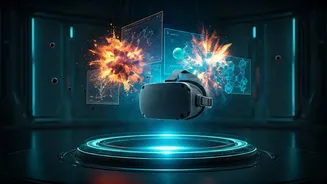
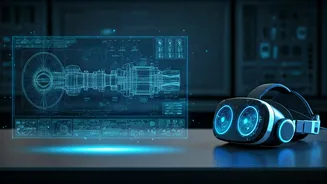
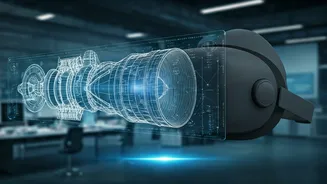
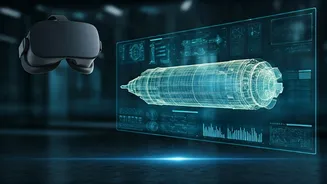
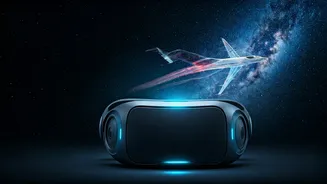
Virtual Reality (VR) offers the first part of the solution. By putting on a headset, a student is no longer a passive observer looking at a diagram; they are an active participant inside a digital environment. Instead of reading about the Oort cloud, they can 'fly' through it, dodging virtual comets. They can stand on the surface of a simulated Mars or watch from a safe distance as two galaxies collide. This sense of presence and scale is a game-changer. VR makes the abstract tangible. The technology transforms a theoretical concept into a memorable experience, creating a strong foundation for deeper learning. It’s the difference between reading a recipe and actually cooking the dish yourself—the engagement level is fundamentally different.
AI as the Cosmic Director
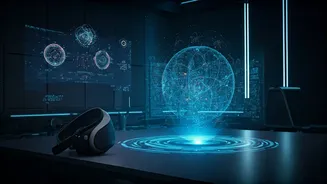
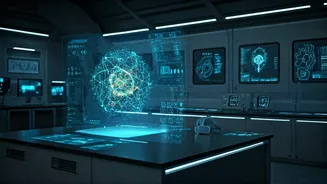
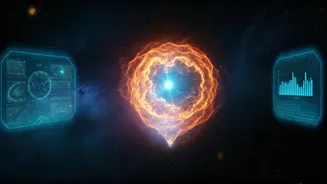
But a static 3D model, even in VR, is still just a model. This is where Artificial Intelligence (AI) elevates the entire experience. The AI acts as a powerful simulation engine, running the complex laws of physics in real-time. It’s not a pre-recorded video; it's a living, breathing digital cosmos. A student could ask, 'What happens if I increase the mass of this star?' The AI can then calculate the consequences and dynamically alter the simulation, perhaps showing the star collapse into a black hole. It can generate procedurally infinite galaxies, each with its own unique properties, for students to explore. The AI serves as the director of this cosmic show, ensuring that everything behaves according to the real principles of astrophysics, making it a true interactive laboratory rather than just a virtual field trip.
The Classroom of Tomorrow
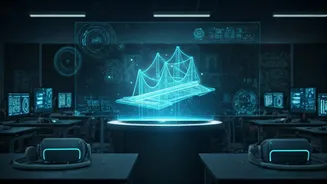
Picture a classroom where a teacher guides a group of students, all in VR headsets, through a lesson on star formation. The teacher can pause the simulation of a collapsing nebula, highlight different areas, and let students 'touch' and manipulate variables like gas density or temperature. Students can work together to solve problems, like plotting a safe trajectory for a spacecraft through an asteroid field whose movements are calculated by the AI. This approach fosters collaborative, inquiry-based learning. Instead of memorising facts, students develop an intuitive feel for complex systems. This isn't just science fiction; institutions like Harvard and MIT have already developed prototype systems that allow researchers and students to visualize complex datasets in VR, proving the concept is sound and on its way to broader application.
Beyond the Stars
The potential of this AI-VR combination extends far beyond astrophysics. Imagine medical students performing virtual surgeries where an AI simulates realistic patient responses, or architecture students walking through buildings that are still just blueprints, testing structural integrity with AI-driven physics. While the technology is still expensive and requires specialised hardware, costs are falling. As VR headsets become more accessible and AI models more powerful, we are looking at a fundamental shift in pedagogy. Companies in the ed-tech space, including many in India, are already exploring immersive learning. The challenge will be to create content that is not only visually impressive but also pedagogically sound, ensuring that this powerful tool is used to genuinely deepen understanding, not just to entertain.