





Meet the Celestial Oddity
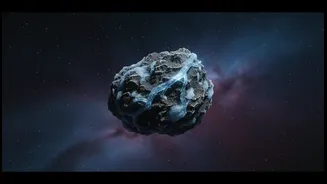
Deep in the main asteroid belt, a region between Mars and Jupiter filled with chunks of rock and metal, resides an object named (248370) 2005 QN173. For years, it was considered just another one of the millions of asteroids orbiting the Sun. Discovered
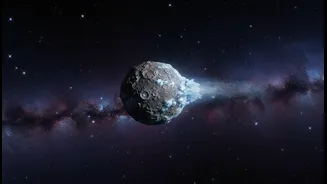
in 2005, it followed a predictable, asteroid-like path and showed no signs of the dramatic activity that defines a comet. But in July 2021, astronomers using the Asteroid Terrestrial-impact Last Alert System (ATLAS) noticed something astonishing: this supposedly dormant asteroid had developed a long, dusty tail, behaving just like a comet. This discovery immediately set it apart, placing it in a rare and mysterious category of celestial bodies.
An Asteroid in Comet's Clothing
What makes 2005 QN173 so special is its recurrent activity. After spotting its tail in 2021, scientists dug through archival images and found evidence of similar activity during its previous closest approach to the Sun in 2016. This pattern strongly suggests that the dust tail is not the result of a random, one-off event like a collision with another object, but is caused by the sublimation of ice—the very process that gives comets their signature tails. As the object gets closer to the Sun in its 5.36-year orbit, the solar heat turns buried ice directly into gas, which then escapes, dragging dust particles with it to form a tail. Because it lives in the asteroid belt but acts like a comet, it has been dual-designated as both an asteroid and a comet, now also known as 433P.
Blurring the Cosmic Lines
This object is part of a growing class known as "active asteroids" or "main-belt comets". Traditionally, astronomy has drawn a clear line: comets formed in the frigid outer solar system, preserving their ice, and have highly elliptical orbits. Asteroids formed in the warmer inner solar system, are mostly rock, and have more circular orbits within the main belt. Active asteroids like 2005 QN173 defy this simple division. They have the orbits of asteroids but the physical characteristics of comets. This suggests that the boundary between these two types of objects is not as clear-cut as once believed and that icy bodies may be far more common in the asteroid belt than previously thought.
Rewriting Solar System History
The existence of main-belt comets has profound implications for our understanding of the solar system's formation and the origin of life on Earth. For a long time, comets from the outer solar system were considered the primary delivery mechanism for Earth's water. However, chemical analysis of many comets showed their water composition differs from that of our oceans. The discovery of icy asteroids in the main belt presents an alternative source. These objects, having formed closer to us, could have delivered the specific type of water that now fills our planet's oceans. The study of these hybrid objects could therefore hold the key to understanding how Earth became a habitable, water-rich world.
A New Era of Classification
Objects like 2005 QN173, which is one of only a handful of known recurrently active asteroids, are forcing astronomers to move beyond the simple "rock vs. snowball" classification. The term "active asteroid" itself reflects this new, more nuanced understanding. The activity can be caused by various factors, including sublimation, collisions, or even rapid rotation causing the object to shed material. Each new discovery provides a crucial piece of the puzzle, helping scientists build a more complete and complex picture of the small bodies that populate our solar system. Astronomers are now eagerly awaiting 2005 QN173's next close approach to the Sun in September 2026, hoping to witness its activity firsthand and unlock more of its secrets.