


A Storm Like No Other
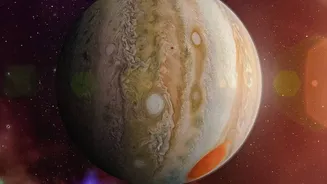
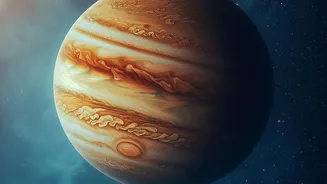
Jupiter’s Great Red Spot is the most powerful storm in our solar system. It’s a vast, crimson-colored anticyclone, a high-pressure system spinning counterclockwise with winds that can exceed 640 kilometres per hour. For context, the strongest hurricanes
on Earth barely reach half that speed. Historically, the storm was wide enough to swallow three Earths, but astronomers have been watching it shrink for decades. This long-term trend has raised questions about its future, but new data is revealing that the story is more complex than simple shrinkage. The spot is not just getting smaller; it's fundamentally altering its behaviour.
The Latest Revelations
Recent analyses of data, particularly from the Hubble Space Telescope, have uncovered surprising new dynamics. One of the most startling discoveries is that while the storm continues to shrink, the winds along its outer edge are actually accelerating. A detailed study of Hubble images from 2009 to 2020 found that wind speeds in the storm's high-speed outer ring increased by up to 8 percent. At the same time, the winds in the storm's central region are moving much more slowly. This finding baffled researchers, as it suggests a complex energy transfer is happening within the vortex. It’s as if the storm is changing its internal structure, becoming more compact but also more intense at its boundaries.
More Than Just Shrinking
The changes aren’t just about wind speed. The shape of the Great Red Spot is also evolving. For years, it has been transitioning from a long oval to a more circular shape. More recent observations have even detected a strange wobbling motion, as if the entire storm is jiggling. Scientists have also noted peculiar filamentary structures and wisps appearing within the vortex, twisting and contorting in the fierce winds. While the spot's distinctive colour has varied over the years, some observations suggest its deep red hue has actually intensified even as the storm shrinks, hinting at powerful ongoing chemical reactions high in Jupiter's atmosphere. These are not the signs of a storm quietly fading away, but one undergoing a significant transformation.
How Deep Does It Go?
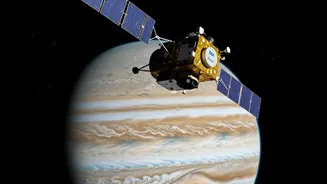
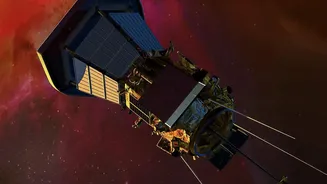
To understand what powers the Great Red Spot, we need to know what’s happening beneath the clouds. Thanks to NASA's Juno spacecraft, we now have a better idea. Using a microwave radiometer, Juno was able to peer deep into Jupiter’s atmosphere, revealing that the storm is not a shallow feature. The roots of the Great Red Spot penetrate at least 300 to 500 kilometres down into the planet's atmosphere, far deeper than Earth’s oceans. The base of the storm is warmer than its top, a temperature difference that likely fuels the ferocious winds we see on the surface. This incredible depth helps explain why the storm has lasted for centuries, but it doesn't fully solve the mystery of its current changes.
Is the End Near?
So, what does this all mean for the future of the solar system’s most famous storm? Will it disappear entirely? The answer is uncertain. Some projections have suggested the Great Red Spot could vanish within the next few decades, based on its rate of shrinkage. However, the latest findings paint a more complicated picture. One theory is that the storm is shrinking because it is 'starving'; it may not be 'feeding' on as many smaller storms as it used to, which could be reducing its overall size. Yet, as it shrinks, it also appears to be growing taller and concentrating its energy. It may not be dying but rather evolving into a new, more compact but stable form. The continued observations by missions like Juno and telescopes like Hubble are our best hope for finally understanding its fate.