




Seeing Through the Dust
For decades, astronomers have been fascinated by Centaurus A, a galaxy relatively close to us at about 11 to 13 million light-years away. The problem was, its heart was hidden behind thick, dark lanes of cosmic dust. Telescopes like Hubble, which see
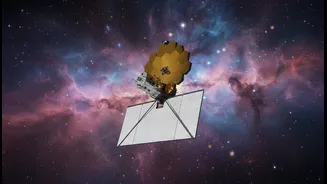
primarily in visible light, couldn't pierce this veil. It was like trying to see through a thick plume of smoke. The James Webb Space Telescope (JWST), however, is designed to see in infrared light. This allows it to cut through the obscuring dust, finally giving us a crystal-clear view of the galaxy's chaotic and active center. Where previous infrared telescopes like Spitzer could see large structures but not fine details, Webb provides both power and sharpness.
A Portrait of Galactic Collision
The image reveals the dramatic scars of an ancient cosmic event. Centaurus A's peculiar shape is the result of a massive collision between a large elliptical galaxy and a smaller spiral galaxy that occurred roughly two billion years ago. Webb's new view doesn't just confirm this; it shows the aftermath in stunning detail. We can see a warped, parallelogram-shaped disk of gas and dust—the mangled remains of the smaller galaxy. This structure glows with the energy of ongoing activity, telling a story of galactic violence and rebirth. Before Webb, astronomers knew the collision happened, but now they can study the resulting structures with unprecedented clarity.
Galactic Archaeology, Star by Star
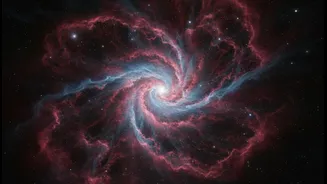
What might look like simple graininess in the image is actually a field of millions of individual stars, resolved by Webb for the first time. This incredible resolution turns the image into a tool for what scientists call "galactic archaeology." By studying the different populations and generations of stars, astronomers can create a timeline of the galaxy's history. They can pinpoint when the original burst of star formation happened following the collision, when activity slowed down, and how new stars are being born from the chaos. The glowing red and purple areas, for instance, highlight stellar nurseries where new stars are forming and old stars are shedding their material back into the galaxy.
Unveiling a Supermassive Black Hole's Influence
At the very center of Centaurus A lies a supermassive black hole, actively feeding on surrounding gas and dust. As it consumes material, it unleashes powerful jets of energy that shape the entire galaxy. For the first time, Webb has allowed scientists to measure the motion of gas swirling near this cosmic engine. They can see warm hydrogen gas rotating in a warped disk while other, ionized gas is blasted outward. This provides a direct look at one of the biggest questions in astronomy: how do black holes and their host galaxies evolve together? The data from Webb shows a complex relationship where the black hole can both trigger star formation by compressing gas and stifle it by blowing away the raw material needed.